 There are certain dining experiences that just make you feel like a New Yorker. Sitting at Veselka’s counter sipping coffee and dipping chalah into a bowl of soup exemplifies this notion 24 hours a day, seven days a week. Originally opened as a candy store in the mainly Ukrainian East Village of the 1950s, “Veselka,” Ukrainian for “rainbow,” has been spreading cheer amidst an ever-changing neighborhood by sticking to its roots: authentic and affordable Ukrainian food in an unhurried atmosphere.
 You can visit a dozen Ukrainian homes and eat as many different kinds of borsch. Historically, meat was only added for flavor, due to the high cost. In modern times, you will most always find large hunks of beef or lamb, sometimes with a bone still attached. Borsch is traditionally served with a spoon of sour cream and an ample stack of black bread slices.
 This deep red, meaty soup is almost a national symbol of Ukraine and Russia. Sugar beets are the main ingredient; you simply cannot call the soup “borsch” without them. Many other vegetables are added to the mix, depending on what village the recipe originated from. These include: cabbage, tomato, onion, carrot, celery, and potato. Some areas of Ukraine grew more carrots than onion, so hence, that regional recipe will be heavy on carrot.
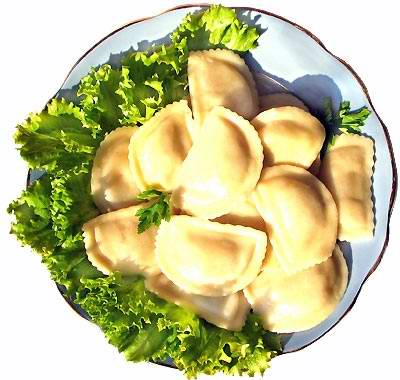
Pelmeni are dough balls stuffed with meat, either beef pork, or a combination of both. After boiling, sour cream is usually added on top. Some modern families even began to eat them with ketchup.
During the winter, peasant women would make hundreds of pelmeni, stuff them into burlap sacks, and hang them outside to freeze. They would wait there in suspended animation like TV dinners, waiting to be taken down, boiled, and eaten. Guests who arrived in the bitter cold would immediately be given a hot bowl of pelmeni to warm up. In those days, pre global warming, winters lasted longer, and were much colder. Pelmeni were an ideal food that could be prepared quickly, stored easily and warmed up within ten minutes.
 The food of Eastern Ukraine is almost identical to that of Russia proper. Most of the population is ethnically Russian, and has been for generations. Traditional cafes in Volgograd or Voronezh, two nearby Russian cities, serve the same food as in Lugansk, and vice versa, with only minor regional variations.


No comments:
Post a Comment