Sunday, February 28, 2010

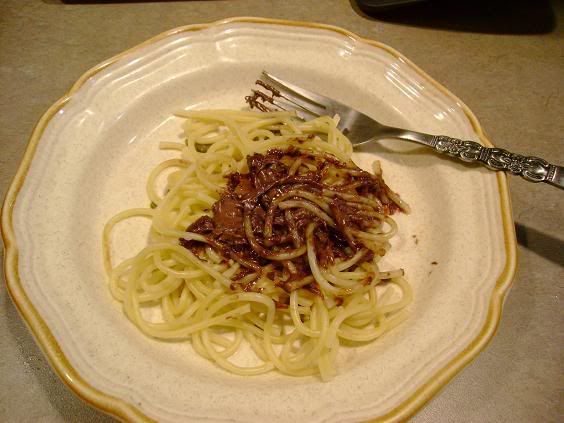
Nutella Spaghetti


I was about to pour alfredo sauce on some spaghetti when I realized the one thing that my pasta was missing: chocolate. So I put some nutella on top of it instead. It turned out just as awesome as I expected it to too.

Here's the recipe:

- cook some pasta
- when you're about to dump tomato sauce or pesto or something on it out of habit, STOP! instead dump nutella on it

I rate this food item two out of two.

Strange sighting in a bowl of soup

Can't quite think who it reminds me of.......any ideas?

Saturday, February 27, 2010

Truth is Stranger than Fiction

My lads essay from school


“There is no way I want to stay a mere human.”
Dr Kevin Warwick

Dr Kevin Warwick is a British scientist and professor of cybernetics at the University of Reading. He left school at 16 but went back to University at the age of 22. He has been doing experiments on cybernetics and robotics. He is the first person (outside science fiction) to actually become a cyborg. A cyborg is a word for a cybernetic organism (part organic, part machine). He is interested in how artificial intelligence can be used to improve humanity and feels that humans are limited in their sense perceptions.

At the risk to his own life, Dr Warwick in Project Cyborg 1.0 (1998) got an implant embedded in his arm. It had a signal unique to his individual requirements and Dr Warwick was able to operate doors, heaters and computers without lifting a finger. This has implications for people who have disabilities. In another experiment Project Cyborg 2.0 (2002), he got a different implant put in. This interfaced with his nervous system and meant that he could control things such as the movements of a robotic arm through thought alone. This is even more amazing when you consider that the robotic arm was on the other side of the world to him. He could also feel pressure that was put on the arm.

Kevin Warwick is at heart an adventurer. He believes that humans need to evolve. By using the technology of silicon chips he feels we can enhance our senses. For example we could be able to see in X-ray, infra-red or up to 8 dimensions. He thinks in future we will not need to communicate through speech but simply through thought alone. He feels speech is a slow and prone to error method of communication. Kevin Warwick sees technology as being more advanced than human beings and that artificial intelligence could take over decisions and eventually be in control of humans because computers can make better and faster decisions. Science fiction points to the dangers of a situation where this might happen and that inspires Dr Warwick to research cybernetics. He wants to be part of a new humanity, what he would see as a better and more evolved humanity. One day he thinks that humans will choose to get upgraded and have enhanced abilities through implants. People can choose whether or not to become a cyborg, but if they didn’t they would be to the new human cyborgs what chimpanzees are to us now.

In Project Cyborg 2.0, Dr Warwick’s wife got a similar, although not as sophisticated chip put into her central nervous system. They were trying to find out whether they could speak to each other through thoughts alone, perhaps by using the internet. They will be looking at questions such as how will the brain adapt to unfamiliar information coming in through the nervous system.

People and animals are already starting to get microchips implanted, for example dogs and children whose parents are over protective and scared of abduction (particularly after the Madeline McCann case). It is thought that in the future these chips will be able to hold all sorts of information such as bank details, medical details and can be updated when necessary.

There are all sorts of ethical questions and Warwick (or Captain Cyborg as the papers call him) works closely with a woman called Danniella Cerqui who is an expert on ethics. It raises the whole question of what it might mean to be human and conscious.

When Dr Warwick heard John Searle’s view that a shoe is not conscious therefore a computer cannot be conscious, he responded by saying “that by the same sort of analogy though, a cabbage is not conscious therefore a human cannot be conscious.”

So what might it be like in the future? Would you get an enhancement to see more clearly, hear better or lift heavier things? Will the world be even more divided into haves and have-nots as this technology may not be cheap? What if we have to have chips in order to get our money? Does having a single implant make you a cyborg? What if an enemy power could use this technology against us by causing death to us through malfunctioning chips?

Progress can never really be halted and people will always use technology to their own ends whether we may judge it good or bad. It looks like this technology will be the way of the future.


WISDOM OF THE WORLD - WEEK 97


The House of a thousand Mirrors


Long ago in a small, far away village, there was place known as the House of 1000 Mirrors. A small, happy little dog learned of this place and decided to visit. When he arrived, he bounced happily up the stairs to the doorway of the house. He looked through the doorway with his ears lifted high and his tail wagging as fast as it could. To his great surprise, he found himself staring at 1000 other happy little dogs with their tails wagging just as fast as his. He smiled a great smile, and was answered with 1000 great smiles just as warm and friendly. As he left the House, he thought to himself, "This is a wonderful place. I will come back and visit it often."

In this same village, another little dog, who was not quite as happy as the first one, decided to visit the house. He slowly climbed the stairs and hung his head low as he looked into the door. When he saw the 1000 unfriendly looking dogs staring back at him, he growled at them and was horrified to see 1000 little dogs growling back at him. As he left, he thought to himself, "That is a horrible place, and I will never go back there again."

All the faces in the world are mirrors. What kind of reflections do you see in the faces of the people you meet?

Wednesday, February 24, 2010

Acupressure Mats make a big Impression


Let’s get to the point, or points. Acupressure Mats take a bit of getting used to. From the moment you lie back on the 6,000 sharp plastic needles on the mat, you know there are forces at work, mainly downward ones as your skin sinks onto these needles specifically designed to target your acupressure points around the body. If you ever wondered what it must be like for the Indian Yogis to lay on a bed of nails, now is your chance to find out.

Ian Gee, who is supplying the Acupressure Mats through his web based company Shakti.ie tells us a bit more of the history of why the acupressure mats are such a huge hit throughout the world.


“The acupressure mats are proving to be a popular choice for people wanting to try a safe, natural alternative to traditional medication. As well as being widely used medicinally in India, Chinese scriptures also recorded the original bed of nails as a treatment to balance the mind and body thousands of years ago. The modern equivalent we supply comes from modern tests in Russia where comprehensive results were produced from hospital patients and prison inmates. The results from these tests proved that the mats had huge health benefits, the doctors were amazed.”

We asked Ian if he uses the mat himself. “ I do, every day. It was really prickly at first but like a lot of things, if stick with it the rewards are there. I find that I can actually fall asleep on the mat now and wake up feeling very chilled out. I feel much more relaxed and energised throughout the day.”

Ian continues to tell us more about how the mat works “The study in Russia showed the bed of nails decreased inflammation, strengthened the immune system, regenerated tissues, increased metabolism and lowered stress levels and has a positive effect on depression. When you lie on the acupressure mat the spikes stimulate energies within your body, triggering a sense of well being.”

“The mat works by acupressure, which is based on the idea that the body has a meridian system, probably best likened to the nervous system. The increased blood flow and release of Endorphins around the body makes the mats effective.”


Does Ian see a big market for the acupressure mats? “Yes, definitely.” And concludes. “Research has shown that the mats can help people with sporting injuries, back pain, neck pain, sciatica, insomnia, digestive problems, poor circulation, fatigue, excess weight, cellulite and all sorts of allergies, so there is a large potential market. I also think the mat gives us something very special every day. Twenty minutes lying down and doing nothing. That’s priceless.”


To celebrate the launching of the new site Ian is offering a FREE acupressure Mat to one lucky winner of a prize draw on the website. Check it out HERE .

The offer ends at the end of March 10.....

Monday, February 22, 2010

1st Day of Internship!


I’m finally doing it! I’m on my internship sem! Honestly, I was not looking forward to it but I was wrong. I kinda like it actually! Thank god there are other 3 trainees with me and they’re all cool! Even the staffs are cool! Damn funny and joke around most time! Lol!
Even though the company is quite a small one but I think it’s better. Know why?!?! When the company is small, that means they have less staffs and when they have less staffs that means they’ll make the interns involve in every project like what I did today. But since it was my 1st day, they only make me do ‘proof reading’ and the ‘squaring’ of the interim payment certificate. Basically it’s just checking the figures before they key them into the computer.
Even the bosses are so cool! =)

Sunday, February 21, 2010

WISDOM OF THE WORLD - WEEK 96


The Teacher and the Taught

A young teacher from an industrial city in the north of England had accepted a temporary job teaching a class of four-year-olds out in one of the most isolated, rural parts of north Wales. One of her first lessons involved teaching the letter S so she held up a big colour photograph of a sheep and said: "Now, who can tell me what this is?"
There was no answer. Twenty blank and wordless faces looked back at her. "Come on, who can tell me what this is?" she exclaimed, tapping the photograph determinedly, unable to believe that the children were quite so ignorant. The 20 faces became apprehensive and even fearful as she continued to question them with mounting frustration.
Eventually, one brave soul put up a tiny, reluctant hand. "Yes!" she cried, waving the snap aloft. "Tell me what you think this is!" "Please, Miss," said the boy warily. "Is it a three-year-old Border Leicester?"

Wednesday, February 17, 2010

Oh You Know, Just The World's Largest Raisin Cake from 1962

Not too shabby, I say. I would've liked to have seen this beauty in person. 7000 pounds of raisins? Noooo problem.

George, what a wonderful shop to behold! Best sign ever. And road arrow is pointing right atcha!

Sunday, February 14, 2010

Xi'an


I came to Xi’an five years ago as a side trip on my way to Mongolia. I came to see the Terracotta warriors, do some laundry and move on. I have a bad memory for images and I have only two strong memories of the place. The first was a dingy little restaurant where dog was an option on the menu and another customer teased me for how I hold my chop-sticks. The other was the long line of shops along my hotel’s street; little one room beauty salons lit by pink lights, all with solitary women sitting at the front doors, calling out to me as I went by.

Xi’an was not a place I gave much thought to returning to. I decided to try it again because a friend in Istanbul recommended it. He pointed out that it was a beautiful city with a lot of universities which lent it a college-town vibe. These good words, plus the knowledge that it was neither a big industrial town nor a sleepy backwater made me gravitate toward it. It would be good, I imagined, to be in a place that was both Chinese and yet full of western amenities when necessary.

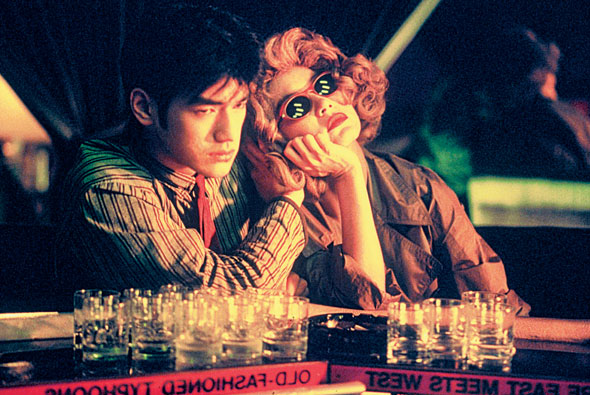
Well, Xi’an was a far cry from what I remembered. Five years had done a number on the city. When I’d stayed here before, the Lonely Planet had recommended a clean, but boring little hotel near the train station—which goes some way to explaining the concentration of brothels. Now there were swanky youth hostels with fancy expat bars lighted like Wan Kar Wai movies.

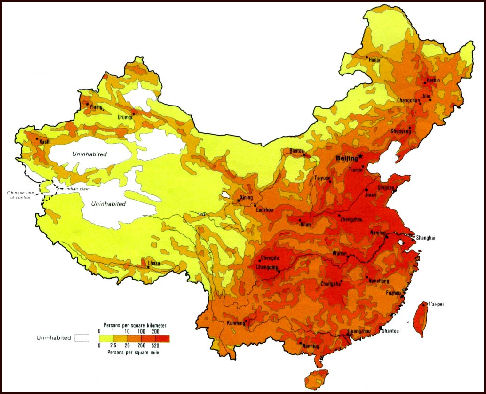
So what is Xi’an? Well, with around 7 million people, it probably qualifies as a second tier Chinese city. But that doesn’t convey much. What matters is that it’s the original capital of the country—the Qin, Han and Tang all had their palaces here—and, history aside, it’s the largest city in the northwest of the country. If you look at a map of the country, the population (marked in shades of red) is all concentrated on the coast. Outside the Great wall, the intensity fades except for a flame of color flaring out westwards to include Xi’an before petering out. Think of Xi’an like Chicago—a mecca of commerce amid vast expanses of nothing.


Living in a place, the layout and the points of interest only slowly come clear. A travel guide will tell you to visit the Big Goose Pagoda and the Bell Tower, perhaps a visit to the history museum and a few other cultural sights, but this isn’t how daily life plays out. In practice, most of my time is spent within a radius of only a few blocks.

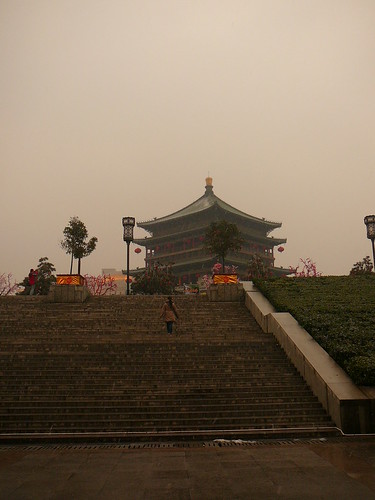
Both my job and apartment are located only two blocks from the Bell Tower and, from this six hundred year old structure, the four main city boulevards radiate off toward the old city walls. Along the west road are numerous fancy restaurants. Along the north, shopping malls. South, more shopping malls. East? Individual clothing stores, banks, and a few hotels. Behind the Bell Tower, in the northwest section, is the “Muslim Quarter,” a recently refurbished drag of little stores selling dried fruit, noodle shops, and vendors hawking knick-knacks like wood-carved frogs.

My house is in the southeast section of the old city near the gargantuan Taiyuan Shopping center and the surrounding clothing and accessory stores. To get to it you take a few turns off the main streets. You quickly find yourself walking along a scruffy alleyway. There’s a flop motel, a few legitimate hair salons and an open air shack selling stale crackers and water before you come to my apartment block.

If you pass by my apartment, you emerge back on a small road running parallel to the main eastern thoroughfare, lined with a mixture of middle, low and basement range restaurants. Scattered along the way are a range of different shops—internet cafes, corner-groceries, bakeries, pirated electronics boutiques and sign-makers.

Not too far from all this is my school, located on the fifth floor of a building shared with a business hotel and a large bookstore. Directly next to it is an empty lot of property. Hidden from the street by a concrete wall, it has become home to a small shanty town of beat-down-looking men. Using scavenged bricks, plastic, wood and other materials, they’ve constructed little huts. There are meeting places with tables and chairs at which they play cards. The men gather together throughout the day around trash bin bonfires.

In the past month, I’ve made it east and south of the city walls repeatedly, but never penetrated in the other directions. The south of the city is chock-a-block with universities and concentrations of clothing stores and restaurants. There is also a financial district with big clean roads, but not much in the way of vitality.

The main southern draw is the Goose Pagoda. Any potential awe the view of this thirteen hundred year old temple might have stirred on my first visit was undercut by the surrounding tourist infrastructure. In my first glimpse of it on a foggy morning, the pagoda seemed dwarfed by a massive KFC built on the edge of the surrounding square. In all directions, new restaurants are going up. All along the westerly running Yanta Street are model foreign restaurants serving Korean, Maylay, Japanese and Indian cuisines. Everything is newly built and, like so much of the development, its existence seems more aspirational than anything else. On the day I visited, every restaurant was empty and the staffs sat at window tables playing cards or gazing.

Such details aside, the whole area seemed promising. There was a cute little park that I could imagine visiting in the summertime and at night the fountains around the pagoda were turned on to provide audiences with the largest light and water show in China.

One particular disappointment to me was that the university district of the city was largely devoid of interest. Nothing distinguished it from other parts of city. There was nothing special in the way of bookstores, restaurants or cafes . . .

And, really, this was the biggest problem with the city as a whole—the undifferentiated sameness of it all. Aside from the landmarks, there was little beauty on display. Life centered around shopping, work, restaurants and home—and nothing would be wrong with this except that the shopping all seemed so repetitive. On a typical day, waking up to cold weather, there was little motivating me to explore and, when I did, the explorations tended to reveal large swaths of sameness. There might be a particularly good restaurant in a given neighborhood, but the surrounding area offered little of interest.

Again and again what saves China from boring me with its alternatively drab, soulless city vistas, is the people. This isn’t to say that Chinese are more interesting than folks in other countries—that the opposite is true is a gripe of a different sort—but they are more friendly and the flow of life around them hums at some higher frequency.

Certain things that grate on one at first—the constant stares and murmurs of laowai and waiguoren—lose their annoyance when their lack of malice becomes clear. Chinese stare because they’re interested and involved. If you have a problem, people will help you. If you are in trouble, you never feel utterly alone.

Moreover, to my eye, daily life in China gives lie to the stereotype (repeated by Chinese themselves), that they are meek and easily herded. I am constantly watching shouting matches break out. Getting on a bus in a free-for-all. And traffic! There are no rules; buses don’t’ stop for pedestrians on red lights, pedestrians don’t wait for green lights (instead you just wander out into the road, lane by lane). All this—and far better examples of such collective madness—are pluses in my way of thinking. When you start considering your own life, back in the states, you realize how regimented everything is. you go when you’re told, stop when you’re told, line up here, queue there. You don’t spit on the street or drive down the sidewalk. You also don’t fall easily into friendship with strangers.

It’s all of a piece; neither good nor bad but thinking makes it so. Xi’an is lacking in a great many departments that matter to me, but it brims with life in a host of other ways.


New Year’s Eve was a perfect example. In the days leading up to the event, streets are peppered with vendors selling fire-crackers. For several days in advance, people set off sporadic blasts with no rhyme of reason. As the midnight hour approaches, the frequency rises until midnight when fireworks start shooting off in every direction. The entire sky becomes full of explosions, lights and smoke.

More quietly, along the streets, outside businesses and—occasionally—in the middle of the highway, Chinese gather in twos and threes to light small devotional fires of money and joss paper.

Amid all this activity, groups of Chinese head to and fro to restaurants or each other’s houses. Everyone out and about is in high spirits. As I walked along with a few other teachers, packs of kids called out new years greetings.

Finding ourselves shunted onto the street when the expat bar finally showed us the door at five in the morning, we teachers made our way onto the streets and began to part ways. Another teacher and I were waylaid by a group of Chinese in their late twenties: Three very drunk men and a pair of slightly tipsy women. Seasons greetings were exchanged and, after some discussion in various broken languages, we all agreed to get food together. Our new Chinese friends had no particular idea of where to go, but an hour of peripatetic wandering brought us to a busy noodle place near the Muslim Quarter.

Around seven in the morning we all said our goodbyes and started to head home. Light was flooding the city’s perpetually gray sky and fireworks were starting up again.
Saturday, February 13, 2010

WISDOM OF THE WORLD - WEEK 95


Testing for gossip

In ancient Greece, Socrates was reputed to hold knowledge in high esteem. One day an acquaintance met the great philosopher and said, “Do you know what I just heard about your friend?”
“Hold on a minute,” Socrates replied. “Before telling me anything I’d like you to pass a little test. It’s called the Triple Filter Test.”
“Triple filter?”
“That’s right,” Socrates continued. “Before you talk to me about my friend, it might be a good idea to take a moment and filter what you’re going to say. That’s why I call it the triple filter test. The first filter is Truth. Have you made absolutely sure that what you are about to tell me is true?”
“No,” the man said, “Actually I just heard about it and ...”
“All right,” said Socrates. “So you don’t really know if it’s true or not. Now let’s try the second filter, the filter of Goodness. Is what you are about to tell me about my friend something good?”
“No, on the contrary…”
“So,” Socrates continued, “you want to tell me something bad about him, but you’re not certain it’s true. You may still pass the test though, because there’s one filter left: the filter of Usefulness. Is what you want to tell me about my friend going to be useful to me?”
“No, not really …”
“Well,” concluded Socrates, “if what you want to tell me is neither true nor good nor even useful, why tell it to me at all?”

"White Castle" Cake


Remember Harold and Kumar Go To White Castle? Don't even bother seeing the sequel. But check out this bonkers cake found here! Pretty sure the ketchup squirt bottle and all the "packaging" is fondant or gumpaste...! BONKERS.

Sunday, February 7, 2010

WISDOM OF THE WORLD - WEEK 94


The Barber Shop

A man went to a barbershop to have his hair cut and his beard trimmed. As the barber began to work, they began to have a good conversation and talked about many things. Eventually they touched on the subject of God. The barber said: "I don't believe that God exists."

"Why do you say that?" asked the customer.
"Well, you just have to go out in the street to realise that God doesn't exist. Tell me, if God exists, would there be so many sick people? Would there be abandoned children? If God existed, there would be neither suffering nor pain. I can't imagine a loving God who would allow all of these things."

The customer thought for a moment, but didn't respond because he didn't want to start an argument. The barber finished his job and the customer left the shop. Just after he left the barbershop, he saw a man in the street with long, stringy, dirty hair and an untrimmed beard. He looked dirty and unkempt. The customer turned back and entered the barber shop again and he said to the barber: "You know what? Barbers do not exist."

"How can you say that?" asked the surprised barber. "I am here, and I am a barber. And I just worked on you!"
"No!" the customer exclaimed. "Barbers don't exist because if they did, there would be no people with dirty long hair and untrimmed beards, like that man outside.
"Ah, but barbers DO exist! That's what happens when people do not come to me."
"Exactly!" affirmed the customer. "That's the point! God, too, DOES exist! Because people do not look to God for help."

Thursday, February 4, 2010

I just love make up!

For those who are not into make-ups or don’t believe in make up to look beautiful, then it’s up to them. It’s their choice and it’s totally OK! But as for me…?!?! I am just so much into make up. I have no idea why, maybe I’m used to watching my mom put them on every time we’re out since I was a kid or maybe I just realized that make up makes everyone especially we ladies look extra beautiful than we really are!
I’ve been watching all these make up tutorials on youtube and it really got me realized that most girls, well most people look 100 times better in make up! I know some people might think, WHAT’S THE POINT? IT’S FAKE ANYWAY?!?! But you know what, I just don’t care coz I look good in them. I mean, compare my face without anything on and with make up make a lot of differences!
Oh yeah some people might probably say, natural beauty is so much more important than some foundation or concealer but seriously?!?!

Not everyone is gifted with smooth radiant complexion that looks super perfect without any flaw! And being a student with super tight budget, it’s almost impossible to get all those expensive facial products that will supposedly give super perfect skin to the consumers.
When I say make up, I don’t mean those super thick 1 inch foundation sticking to the face with super duper bright purple or green or blue eye shadow.


It’s basically mean a touch of foundation that will cover those flaws or the uneven skin tone (like I have and I just wonder how to fix that!) and some eyeliner or mascara to make those eyes pop up a lil or maybe just touch of some natural shades of blusher to make those cheeks look more radiant than the normal dull one. Well, of course if you would prefer putting some extra for some special occasion, WHY NOT?!?!


This is nice..really!

I once went to this Clinique beauty talk in my college and the guy who was giving the speech actually advised us to put on make up to work and especially when we’re going for any interviews. He said that it just gives the impression of being presentable and always being ready. But then again, of course not too thick...he advised to stick with two colours and I remembered 3 of the main colours for interviews. Those are BLUE which means CONFIDENT, GREEN for POWER and BROWN for MATURITY. So there you go people, why I just love make up so much!


Some of the 'before and after make up' looks...make up DO help don't they?!

Wednesday, February 3, 2010

Ding Dong, Your Pizza's Here!

Crazy miniature pizza! Found here.

Photos: Xi'an, First Month

Click HERE for photos.

First Impressions


On the evening of my fourth and final day in Shanghai, I was sitting in a busy little hole-in-the-wall restaurant off Nanjing Street, working my way through a plate of mixed entrees—green beans, noodles, a forgettably flavored tofu, and equally non-descript meat—when a man began speaking at me from a nearby table. He was dressed in a zhongshan suit and cap; pinned to his chest were a number of red ribbons and a picture of Mao. He was middle aged and comfortably filled out his uniform.

“Good food here, yes?” he called out to me. The various other customers—all of us being closely packed together—glanced up upon hearing English. A few guys flashed grins at their girlfriends.

“Yeah, it’s good.”

“You like Chinese food?”

“Sure.”

“Do you like China?”

“Yes,” I answered a little more hesitantly, wondering how all this was tending, “I think it’s a very exciting place.”

“Exciting,” he rolled the word around in his mouth a moment, “Yes, exciting. I’m from Taiwan, you know.”

“Oh . . .so you prefer it here, I imagine.” The thought of his outfit going over well in Taipei didn’t seem likely.

“Yes, I moved here in 2000. Taiwan is in decline. China is on the rise. May I sit?” he indicated at the seat across from me.

“Sure,” I was curious to see where this went and, anyway, it seemed ridiculous to be shouting at each other across the room.

“You see Taiwan’s manufacturing base is disappearing. No one makes things there anymore. All the factories are moving to China.”

“I suppose I don’t see as many “Made in Taiwan” labels anymore . . .”

“No.”

“And what is your job?”

“I’m retired. But I was an importer-exporter. Now I teach Chinese to foreigners. Here’s my card.” He handed me a business card with a great deal of Chinese on it that I could make nothing of. The name on the card said “Nelson Mandela,” but this was crossed out and, written above it, was the name Nelson Chu.

“You know who Nelson Mandela is, yes?” he said, eyeing me.

“Sure.”

“He’s my hero. Do you like my card? Why do you come to China?”

“I’m going to teach English in Xian.”

“And why China?”

“It seems like a very interesting place. It has a unique culture . . .”

“Yes very ancient. Do you think China is overtaking America? Is America in decline?”

“People say America is declining, but I don’t know. Twenty years ago they said the same things about Japan. Japan was going to overtake America . . .well, that didn’t happen. I think China is developing, yes, but I don’t think it has to be a competition. There’s room for both . . .”

These thoughts clearly didn’t please him greatly—a dyspeptic shadow had fallen across his face. Yet, momentarily, he roused himself and resumed his odd good humor. As I casually hurried to finish my meal, he quizzed me about my education and whether I was interested in Marxism. I recommended that he read A People’s History of the United States and, my food finally finished, said my goodbyes.

Although this man was clearly unbalanced in some regards, his basic points were sound enough. In some form or another this idea of American decline had been bouncing around my head during the whole of my time in the city. Now, of course, I wouldn’t have phrased it that was at the time. In the moment, what I felt was a more generalized sense of unease and displacement. The difference between the China I had expected and that which I encountered was startling.

During my first few days, I had been to neighborhoods as nice as any I had encountered in Seattle or New York. Actually, nicer. I had wended my way down one major street that was lined with designer jewelry and fashion boutiques which gave way to mammoth shopping malls and hotels. Walking down this street were Chinese dressed in the most chic of clothes. (There were also large numbers of wealthy westerners here—mostly well-heeled-looking men, lock-armed with Chinese women.)

And undergirding all of this was a vast army of laborers. As I came to the end of this particular street (that is to say the point where any destinations accessible by foot fell away and were replaced by the sort of massive landmarks one only pulls up to in a car) I found myself alone, walking down an endless boulevard lined with trees, all lit up with white Christmas lights. The sky was now pitch black and this lifeless luminescence—lifeless because there was not a soul but me to appreciate it—was almost painfully beautiful. Standing, considering all this, I heard a clanking noise and turned my head upwards to see a man, perched in one of the trees, slowly curling lights around the branches. Here it was seven o’clock at night and this man was still toiling away, manufacturing the beauty.

Shanghai was a beautiful city, but it was a very particular sort of beauty and not one I cared for. Istanbul had been unbearably beautiful. Lining the Bosphorus were the most luxurious of houses and enclaves. All of these places had radiated a sense of wealth, but it had been a wealth in repose; the way one pictures the old plantation south. The money was there, but it was tied to a life of leisure and beauty, of fine architecture and the smell salt water.

Shanghai had the feeling of new money. The wealth was all there on display—you were always being bludgeoned by it. Every building eagerly screamed at you: This cost money! There was no subtlety and, surely, that was the point. Here was a city on the rise, on the make, eager to remind all of what it had become. This was highly effective. I was never unconscious of how robust an act of creation the city was and how pale and anemic the world I came from was in comparison. Civilization in Shanghai had the sense of passing through an heroic age where great things were possible whereas America had passed such a point. It was impossible to conceive of American cities every again experiencing the degree of change Shanghai was undergoing. The America I knew no longer had the will for such concerted displays of greatness.

But—and this is the crucial point—I would not want to live in Shanghai. The city was a wasteland. All the beauty was artificial. The closest one could come to nature was a walk along the banks of the Huangpu River. Here one could sit on benches and view the city skyline, but even from this vantage the only beauty was that of constructed things.

And away from the city center things were worse. My hostel’s neighborhood, on account of its numerous markets and small restaurants, had a more down-to-earth vibe that appealed to me, but it was also an endless sprawl of gray building and omnipresent dust. The most pleasant discovery I had while there was to wander into Lu Xun Park on Sunday and find the whole place alive with activity. In one section there was martial arts practice, in another yoga, in another salsa dancing, patriotic singing, kite flying and ballroom swing dance. Most of the crowd was older and all seemed to be thoroughly enjoying this time out and about. Yet the whole park was drab and dusty. The waterways were brown and stagnant. The only thing that redeemed it all was the humanity and the high spirits of all involved.

On my last day in the city, heading to the train station, I got off the subway a stop too early and found myself in a part of the city that looked as though it had been dreamed up by Cormac MacCarthy. All was brown and hazy with dust. No green was to be glimpsed and the various storefronts all seemed to be in the process of decay. The train out of the city revealed endless swaths of ugly apartment blocks, often pressed up again shanty-houses.

That it was no worse than what I had seen in other cities was a fact which I tried to keep at the forefront of my mind. I might have seen better vistas than Shanghai had to offer, but many residents of this city doubtlessly had not. What I viewed as depressing could easily be given a different construction: What people living in China at this particular historical moment were witnessing was a vast act of self-creation. The city was surging to life in every direction one looked. It was the speed and the scale that were amazing—not necessarily the aesthetics. To be a Chinese at this moment was to see a profound change underway of which all the dust and gray and the ugliness was a symbol. To them it might well be reason for soul swelling optimism. Someone like myself coming from a cushy background, where the dirtiness of progress had been long ago swept under the rug, perhaps lacked the requisite perspective.

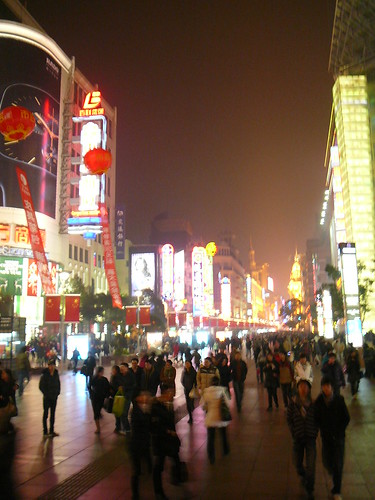
It was this sense that divided my mind much of the time I was in Shanghai: Distaste for what I was personally experiencing balanced by a deep awe in the face of it all. As I made one last pass up and down Nanjing Street, beneath blaring neon signs, through surging crowds and past touts who, somewhere around ten at night, switched from hissing “watches and bags” to “girls,” I tried to ditch my qualms. It was easy to do. In the face of such vitality, such light and energy, how could one think about the downside of things. Walking down the street, the world felt young and all seemed possible.

Tuesday, February 2, 2010

Certain things just make you feel beautiful…

How should I start this?!?! Have anyone of you ever been out…(clubbing especially) with some girl friends and sometimes you felt threatened by their beauty that you feel you wish you have had a better nose, better eyes, better face bone structure, better body, taller…and these stuffs that you can never change! Unless you’re parents are super duper rich then you can consider plastic surgery to fix some of the imperfection in your body BUT even so, there are certain things that not even plastic surgery can help! For example, being short and you wished that you’re at least an inch taller or you have this big upper arm that looks ugly in sleeveless tops cos you’re born with bigger bones and you wish that they’re smaller.
Well that’s how I feel every time I’m out with certain friends or my boyfriend friends’ girlfriends! Oh god I feel so so unattractive even if I’m in my best outfit and make up and they’re in their T-shirt and jeans with NO make up! Well, admit it the make up DO make you look and feel beautiful!
These girls just got it! They have this perfect body, perfect height (which makes me feel like midget when I stand next to them) perfect sharp nose, perfect eyes with just a glide of eyeliner is enough to make them look super gorgeous! How do I compete with that?!?!?! Anyway this is not really about competing but sometimes when you’re always surrounding by physically ‘perfect-looking’ girls, it just brings your self esteem down. *sigh* You just kept asking ‘WHY DON’T I LOOK THAT PERFECT? IT’S NOT FAIR SOME PEOPLE GET TO LOOK SO PERFECT!’
And that was how I felt for quite sometimes till I realized that everyone’s different and they’re special in their own way.
This was what happen, a day before, as I was walking in The Mall (yeah I’m always there cos it’s just right behind the apartment and it takes like 2 mins to walk there) to meet up my bf and their friends, suddenly there’s this Turkish guy came to approach me at the escalator and started to introduce himself, asking where I’m from and stuff. I was kinda surprised cos no one ever did that to me. But he said this, ‘I’ve seen you so many times here in this mall, and every time I just couldn’t brace myself to talk to you and today I did it! Btw you’ve got the most amazing eyes!’
Well of course I felt fluttered cos the eyes that I always wished to be bigger actually been complimented!
Then something else happen on the night at the very same day. My bf’s band had to replace some band to perform in Quatro, The Spring lounge. Since this place has 4 seasons’ clubs in it, instead of going to The Spring with the band, I went to The Autumn club which plays more kinda ‘dancing’ up beat songs! Entrance is free for ladies too! Lol! So, there I was in the club A-L-O-N-E drinking at the bar while pretending to be interested in the Arsenal vs Man U match, where everyone else was either with bunch of friends or with their partners. Then, came 1 guy started to introduce himself and stuff (which is also the first time it happens to me in a club!) asking where I’m from and bla bla bla..and he said the very same thing, ‘YOU’VE GOT BEAUTIFUL EYES!’ I was like ‘oh really?’ (Blushing of course..lol!) Oh, and he’s a Jordanian.
So, there you have it. I got TWO numbers in one day! Lol! Not like I’m gonna call them but it just boost out your esteem a lil bit!
So no matter how you wished you can look better than you are now, certain things just can’t be altered or changed! It is you who can make the best out of it and live with it rather than complaining bout it all the time. No matter how much I always wished I have had a perfect looking body but I just can’t get it… YET! (see, I hate working out and anything associate with something that will make me sweat!) And it all comes down to the people around you, your loved ones! Just a few days ago, me and my bf were eating and as usual he was checking out the Malaysian ‘junk-in-trunk’ and he said, ‘Malaysians do have nice butt don’t they! Regardless of their body shape, they have this nice round butt and most of them have nice body shape like that girl, there, there, (and he started pointing to some girls until..) and you yourself!
I know I know, I might not have the best body ever but it feels nice to have your loved one actually saying something sweet bout you.
So my point here is that, just be happy with who you are, how you are cos at the end of the day, the heart is all that matters (trust me, my bf never go for their own kind no matter how gorgeous they are cos he said all the girls have this bad attitude problem that and every time he thinks about it, it just turns him off, as in not interested in them) and beauty is in the eye of the beholder!