Tuesday, June 22, 2010

Playing in PerĂº


"PERUsing Lima" has changed locations. Friends and family were reporting problems viewing and commenting so "Hello, BlogSpot."

I've been putting in a lot of work time at the office trying to organize meetings in Europe for our Executive Director, Susana, and George. They left yesterday, and I'm still rushing to send emails and make phone calls to Finland, Denmark, Barcelona, and Madrid.

As a stress reliever, Annie (my roommate), our friend Edrina, and I took a bus early on Saturday morning to Ica. Ica is an oasis in the middle of the Peruvian desert. That's right...Peru has a full-blown desert complete with sand dunes, cacti, and scorching temperatures.

The only seats available on the 7:30 bus were First Class so we spent a wonderful 4 hours in spacious, fluffy chairs watching "Valentine's Day" and eating complimentary muffins. In Paracas, we switched seats to Second Class on the upper level (double decker). Small, sardine-can seats sans fluffiness. Remind me to always bus First Class.

We arrived in Ica around 1:00 and grabbed a taxi to one of the hostels listed in Annie's "Lonely Planet Peru" book. Coming out of the bus station, I told the driver the name of the place and someone behind me said "No existe." I was sure that he wasn't talking to me. Our driver cruised the street three times before we figured out that the hostel "no existe." Two years ago, downtown Ica was destroyed by a "teremoto" or "earthquake." The hostel was one of the building to go. Luckily our driver knew another "hospedaje" close to the city center and took us there.

We booked it to the city center "Plaza de Armas" to buy tour tickets for the next day, then took a cab to "El Encanto de la Huerta" or "The Enchanted Garden," a nice restaurant with delicious food, an outdoor deck, a garden equipped with tree-trunk tables and chairs and hammocks. Most of the patrons were local families ordering "chica" and plates and plates of whole "cuyes"...that would be guinea pigs...whole, staring-at-you guinea pigs.


We stuffed ourselves with "Arroz con pata" (Duck and a deliciously seasoned rice), "Ceviche" (specifically Peruvian dish of sea fish marinated in lemon), and a variety plate of meat and baked sweet potatoes. We paid and rested in the hammocks in the garden.


After our short siesta, we took a "auto-taxi" (the Peruvian equivalent of an Indian rickshaw) to the famous, Regional Museum of Ica, a collection of artifacts from several ancient Peruvian cultures from 2000 BC to 1500 AD. The museum included a one-room display of mummies and bodies preserved by the Peruvian desert. The collection included ancient skulls sporting decorative Incan hair pieces, shrunken (yes, shrunken) trophy heads with dismembered tongues (yes the tongues are still there), and skulls that had been aesthetically and purposefully deformed to become very oblong. I didn’t feel that those particular pictures would be appropriate to post.

We left the museum around 4 pm and took yet another taxi to Wacachina, a “laguna” and oasis nestled between sand dunes as big as mountains. Tourists could strap boards on their feet and speed down the slopes or take a dune-buggy and roar around kicking up a lot of sand.


Skip to Day 2 (Sunday) of Ica trip. The tour bus/minivan picked us up at our “hospedaje” at 6:45 am and drove us to Paracas on the coast. We were met by…


The hombre in the picture trained these pelicans to follow him around. He would feed them and then hold out his hat for soles. Not a bad deal really.

Next, we piled into a huge speed boat and took off toward las Islas Ballestas. On the way, we came upon a school of dolphins!


Next we stopped at the “Candelabra,” the design of a candelabrum drawn into the side of a hill 1000 years ago.


Finally, we arrived at the Islas Ballestas, a series of huge, bare jagged rocks off the Peruvian mainland. They call them “the poor man’s Gallapagos Islands.” The islands are monstrous, gorgeous, and covered with birds including “penguinos” and “lobos del mar” (sea lions). Almost every square inch of the islands are covered in birds. It’s incredible. It’s beautiful. It stinks! Think about it…thousands upon thousands of birds making poop. The smell will knock you off of your feet. Boats visit the islands every seven years to collect the guano for sale. See large mountain of guano.


However, you get used to the smell, and seeing penguins and sea lions makes up for it.


It was very cold on the boat though! Thankfully, we layered up.


The next leg of the trip was certainly warmer. The tour agency we used gave us a car and a tour guide, Guillermo, and we set off into the desert toward Nasca, Peru. Note: along the road we saw several “hermitas” which are small chapel-like structures in memory of those who died in traffic accidents. It was disconcerting, because there were so many!


We drove and drove through the desert.


Our first stop was not the Nasca Lines but the Paracas Lines. These small figures were drawn into the sand 2000 years ago.


The next stop was the Nasca Lines (at least three of them). Ok, so the Nasca Lines are HUGE figures (monkey, frog, tree, man, lizard, bird, etc.) drawn into the sand 1000 years ago by the ancient Nasca culture. It never rains in the desert and no one has lived there in over 500 years, so the figures have been well preserved. The Pan American highway destroyed at least two figures and a barrio of Nasca was built over several others. Annie, Edrina, and I saw “Los manos” (the hands) and “El arbol” (the tree).


We also did some trekking through the desert looking at some lines created 500 years ago by the Incans.


The final leg of our trip was to the “Acueductos” (Aqueducts) of Nasca (built by Incans a little over 500 years ago.) Guillermo (our guide) tried to explain the system to us. We googled it later.


We arrived back in Ica on Sunday night at 7:30 pm. We needed to get back to Lima so I could go to work Monday morning. Unfortunately, our reputable bus company that provided the comfy First Class didn’t run after 6:30 pm. We were forced to take a bus company that we were previously told NOT to take. We soon figured out why. The bus was dirty, the seats were built for midgets, and I was almost robbed while I was sleeping. Thankfully, I woke up in time to slap and wandering hand away from my camera bag. However, despite all that, we got back to Lima safely at 2:30 am with tons of pictures and cool souvenirs.

Monday, June 21, 2010

Photos: Dongxin Night Market


Click HERE for photos.

Competition


Two Acupressure Mats worth €35*to be won


Gardening.ie have joined up with Shakti.ie and have two Acupressure Mats to win.

What are Acupressure Mats?

Acupressure Mats have thousands of tiny spikes on a soft cotton base that release endorphins in your body when you lie on them. They are a great way to relax and ease the muscles (especially after a hard day in the garden)


Are they just for Gardening?

The mats can be beneficial when you feel low in energy, experience high stress levels, suffer from insomnia, have muscular tension, lumbago, sciatica, migraine, digestive problems, and depression. Research also claims benefits for people with: Back and neck pain, sciatica, insomnia, digestive problems, poor circulation, fatigue and excess weight.


The is a new Business Section on the site so you can find suppliers. And let’s not forget the forum and FREE Classified section.


*includes postage

Closing date: August 15th 2010

Saturday, June 19, 2010

WISDOM OF THE WORLD - WEEK 111


I will not die an unlived life

I will not die an unlived life.
I will not live in fear
Of falling or catching fire.
I choose to inhabit my days,
To allow my living to open me,
to make me less afraid,
more accessible;
to loosen my heart
until it becomes a wing,
a torch, a promise.
I choose to risk my significance,
To live so that which came to me as seed
Goes to the next as blossom,
And that which came to me as blossom,
Goes on as fruit.

Dawna Markova

Friday, June 18, 2010

Thursday, June 17, 2010

New Articles


What’s the Matter With Chinese Football?


Type in “China football why bad” on Google and a slew of answers quickly present themselves. Among the first hits are news articles detailing sex scandals, corruption prosecutions, and lopsided game losses. There aren’t a lot mentioning victories.

The question remains why?

Message boards are full of theories—mostly ignorant or racist—that don’t hold up on close examination: If Chinese people are too short, Pele and Maradonna have some explaining to do. If China’s developing country status is to blame, then Brazil and most African countries should be doomed to failure. If a certain national apathy toward the sport were the cause, the US shouldn’t be qualifying either.

Rather the problem seems largely to be the way sport is organized in the country. Sports where China does well—swimming, hurdling, and gymnastics for example—are heavily state-directed. Students are selected early and groomed for athletic success. Football is not among the sports that received a great deal of government largess.

In many countries there exist competitive and thriving professional football associations. These teams develop players over years. China’s Super League (CSL), however, is a shambles, currently under investigation for massive corruption. So far over twenty people—including many league executives—have been arrested for game-fixing and gambling. Apparently, entire teams were co-opted by criminal organizations and induced to take dives.

And, although it may be something of a chicken or the egg question, even if these institutions were running smoothly, the society at large is not focused on the sport (and sports in general) with the same enthusiasm as elsewhere. Football remains the most broadcast sport on CCTV5, but talk to Chinese children about which sports they enjoy and the answer will typically be ping pong and basketball. The former has long been popular and the latter has an internationally famous player to look to.

Nor are sports looked on as a legitimate career path to pursue. From a young age students are pressured to focus on their academics and prepare for the grueling and decisive test that awaits. Non-academic extra-curriculars are kept to a minimum in China. Inter-school athletics are negligible. School life does not revolve around athletics as it often does in the States. A kid with a passion for football just won’t find the same degree of family and community support as he would in Europe and elsewhere.

Finally, there is the simple fact that the Chinese team just isn’t that good. It’s in the same division as Japan, North Korea, and South Korea, all of which field competitive teams. China has won against major national teams in “friendlies”—it’s only the qualifying matches where success consistently alludes them. When they last made it to the World Cup in 2002, they failed to secure a single goal in three games.

In the following years the team has not faired much better. Besides losing when it counts, they have developed a bad reputation for thugishness—Tan Wangsong kicking a Belgian player square in the crotch during the Beijing games led a fan to quip that, although the team had failed to medal in football, they’d won “a medal in martial arts.” Similarly, the thirty-man melee between the Queen’s Park Rangers and China’s under-23 team in 2007 did nothing to soften the image.

All is not lost of course. Bad as they have since performed, the Chinese did make it into the World Cup only 8 years ago and the women’s team was in the 1999 finals. In sheer numbers, China commands the world’s largest football fan base. Perhaps a great Chinese player will emerge to inspire youths to play more and encourage parents to cheer them on. Or perhaps hosting the games will become the next big national ambition now that the Olympics are past and the Expo is nearing its close; such a moment on the international stage might spur the country to finally achieve.

In the meantime, however, China lags behind the competitors and pin-pointing the precise cause will doubtless remain a topic of barroom debate for years to come.


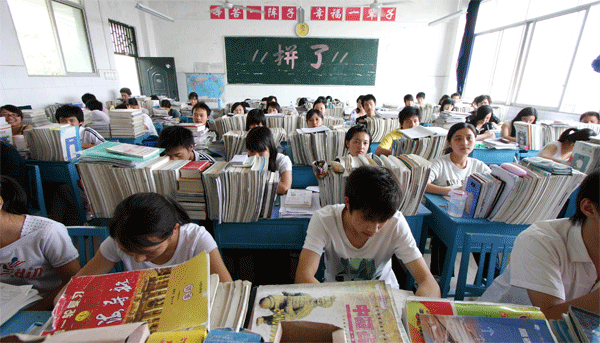
The Gaokao


Articles by western writers about the gaokao, China’s annual college entrance examination, always lead off with anecdotes; stories of parents crowding around schools in nervous vigil, of cities enforcing two-day long construction suspensions and noise-pollution bans, of tearful late arrivals begging on their knees to be let in, of taxi drivers given special right-of-way dispensations if carrying test-takers test-centers, of criminal rings busted for selling thousand dollar cheating apparatuses, of girls taking pills to insure their physical and academic schedules do not accidentally align, of students committing suicide in desperation. In short: Collective hysteria.

To westerners—certainly an American like myself—there is something mad about the test. Our own SATs are stressful, but they are not the be all and end all. A middling score combined with obvious talent—say sporting prowess or community involvement—can open as many or more doors than mere good grades.

Yet China is not like this. Whereas social life in American school revolves in large part around extra-curricular activities, for Chinese no such thing exists. School can last over ten hours a day, five days a week. Weekends are full of English classes, music lessons, and math preparation. Evenings consist of studying, watching tv, and temporarily escaping stress through online gaming and chat.

Years of school lead up to the gaoako and amid an array of statistics—9.5 million test takers, 6 million spots, a 68% acceptance rate for university—one stark number explains it all: 70,000 of this year’s college graduates are still unemployed. Over the past decade, in addition to the boom in apartments and factories, there has been a boom in universities. Whereas 1 million Chinese graduated in 1998, 6.3 million did last year. Job creation is not quite keeping pace and the gap in quality between universities is seen as being the crucial difference. Get into a good school and a job is assured, get into a second tier university and nothing is certain. (The five year olds whom I teach English to may not realize it, but they are already fighting for their futures.)

Tests as the sole portal to advancement are a Chinese tradition dating back nearly 1500 years. The test in its current form dates to 1978 when Deng Xiaoping reintroduced it as part of his reforms. Initially controlled entirely by the Ministry of Education, its devising has been handed over to the provinces during the subsequent years. Depending on the province, students must select their universities before or after the test. This often results in a student doing better than necessary for the school he chooses or, even worse, a low score preventing a student from attending the schools he has listed.

Universities for their part set quotas of how many students will be accepted from each province, the lion’s share given to their own provinces. Test scores are the main criterion for choosing who makes the cut. Other (marginal) considerations include minority status and success in various academic competitions.

For years the exam was held in July, but for the past several years it has been administered in June as to avoid the intense summer heat that blankets China.

The test itself is nine hours long and divided into three required topics: Chinese, Math, and a foreign language. Six other topics (Chemistry, Physics, Biology, History, Politics, and Geography) are usually chosen in addition. The most head-scratching part may be the essay portion where students are required to expand on a prompt. Localities can design their own—Shaanxi’s offered an anecdote about how goldfish only grow as big as their bowls and asked students to ruminate on the connection of environment and success—or they can use the nationally provided prompts. This year’s prompts called for students to discuss light reading or to expand on the saying, “Why chase mice when there are fish to eat?”

Abstract as this many sound, it offers room for a modicum of creativity. Most of the test is directly dependent on a student’s aptitude for rote memorization. The persistent criticism of the Chinese education system is its emphasis on teacher-centered learning, the test both reflects and privileges this style of education—even essay responses are the result of endless studying of rhetoric structure.

The overall score is out of 750. Students attempting to enter the nation's best schools—like Beijing’s Tsinghua University need scores between 660 and the low 700s to even have a sliver of hope. By contrast, equivalent programs in Xi’an require scores in the high 400s. With such fierce competition, there is obvious benefit to those whose parents can pay for expensive after-school prep classes.

Yet, if the goal is to equal the playing field for students, the alternatives are not particularly satisfying. Although China’s education and test policies may not encourage outside-the-box thinking, few from western countries can argue with a straight face that their own countries do any better at helping the poor rise up or limiting the benefits that flow from wealth and position.

If China looks to rags-to-riches success stories as evidence that the system is working, many in the upper-middle class are increasingly less convinced. One last statistic is important to consider: Last year as millions of Chinese youths struggled to get into the best national universities, nearly 250,000 opted to go abroad to school instead.

Sunday, June 13, 2010

Grants


INISHOWEN DEVELOPMENT PARTNERSHIP


The Inishowen Development Partnership is inviting applications from Inishowen-based groups under its Local Community Development Programme as follows:


SMALL GRANTS FOR COMMUNITY GROUPS


Applications are welcome from community groups who are engaging in projects to promote social inclusion. Funding may be sought for project work, training and development.


INFORMATION EVENINGS

Monday, June 21st at IDP Offices, Buncrana 7.30pm
Wednesday, June 23rd at IDP Offices, Carndonagh 7.30pm


More information will be available at the information evenings. If your group wishes to apply for grant aid please contact John Jackson john@inishowen.ie or Denise McCool denise@inishowen.ie at the number below. Application forms can also be downloaded at www.inishowen.ie

CLOSING DATE FOR RECEIPT OF COMPLETED APPLICATIONS
4.00pm Wednesday, June 30th 2010

Completed applications should be returned to John/Denise at Inishowen Development Partnership, St Mary’s Road, Buncrana, Inishowen, Co. Donegal
TEL: 074-9362218