Saturday, May 29, 2010
WISDOM OF THE WORLD - WEEK 108
'if '
If you can keep your head when all about you
Are losing theirs and blaming it on you;
If you can trust yourself when all men doubt you,
But make allowance for their doubting too;
If you can wait and not be tired by waiting,
Or being lied about, don't deal in lies,
Or being hated, don't give way to hating,
And yet don't look too good, nor talk too wise;
If you can dream - and not make dreams your master,
If you can think - and not make thoughts your aim;
If you can meet with Triumph and Disaster
And treat those two impostors just the same;
If you can bear to hear the truth you've spoken
Twisted by knaves to make a trap for fools,
Or watch the things you gave your life to, broken,
And stoop and build 'em up with worn-out tools;
If you can make one heap of all your winnings
And risk it all on one turn of pitch-and-toss,
And lose, and start again at your beginnings
And never breath a word about your loss;
If you can force your heart and nerve and sinew
To serve your turn long after they are gone,
And so hold on when there is nothing in you
Except the Will which says to them: "Hold on";
If you can talk with crowds and keep your virtue,
Or walk with kings - nor lose the common touch;
If neither foes nor loving friends can hurt you,
If all men count with you, but none too much;
If you can fill the unforgiving minute
With sixty seconds' worth of distance run,
Yours is the Earth and everything that's in it,
And - which is more - you'll be a Man, my son!
Rudyard Kipling (1865-1936)
Friday, May 28, 2010
MIA: Missing in Action/Mother in Action
I'm hoping to start blogging again. The Jazz Monkey appears to be taking naps now. So, perhaps, maybe, if I'm lucky, I will be able to start writing again. Maybe even baking again.
In the meantime, here's to a long weekend, the vegetable garden sprouting, and strawberry season peaking over the horizon.
MIA: Missing in Action/Mother in Action
I'm hoping to start blogging again. The Jazz Monkey appears to be taking naps now. So, perhaps, maybe, if I'm lucky, I will be able to start writing again. Maybe even baking again.
In the meantime, here's to a long weekend, the vegetable garden sprouting, and strawberry season peaking over the horizon.
Saturday, May 22, 2010
Street Food

[Again, this is one of my magazine articles.]
Without a doubt, my most pleasurable moments in Xi’an have come, sitting on little plastic stools at less-than-entirely-sanitary tables, savoring a plate of noodles (5 yuan) and watching the whole madcap nighttime drama of the city unfold around me. I seldom feel more connected with my fellow city-dwellers than I do crowded around a chao bing cart, rummaging amid piles of vegetables, meats, and tofus for the perfect midnight meal combination.
Xi’an is highly regarded for its variety and selection of street food. Weather (and other factors) permitting, you can find vendors at any time of day. That said, the variety of food on offer shifts over the course of the day and there are definite differences between the food one can find in the morning, afternoon and night.
Morning
As early as 7 in the morning, small carts line the streets. Most breakfast food involves either eggs, flour or a combination of the two. The most common morning treats are you bing and you tiao, fried dough. Bing is circular and tiao is long and stretched like a garlic stick; both have a taste reminiscent of a slightly salted donut and neither should cost more than 0.5 to 1 yuan. Typically Chinese will eat these with soymilk. Bing can be stuffed with shredded potato or spiced cabbage.
Another vast category of breakfast food is fried stuffed bread (bing). Unlike the simpler fried doughs, these are filled with chives (cong), eggs (jidan), or meat (niu rou) before they are cooked. Less unhealthy looking are the grilled versions of the same thing. None should cost more than 1-3 yuan.
If your preference is for something less artery-clogging first thing in the morning, options up your alley might include steamed bread (mantou) stuffed with veggies or any of the readily available spicy soups (hula tang). Also low fat is jian bing guozi—essentially a crepe filled with egg, chives, and onions.
Afternoon
Between morning and night a great many vendors either vanish or re-locate. Streets like Dongmu Toushi—at other times overflowing with food—become rather desolate save for men hawking pineapple on a stick (1-2 yuan).
There are notable exceptions. At lunchtime, along the backstreets, women pull out their large lunch carts full of meats, greens, rice, and noodles (kuai can). Most noticeable is along Luomashi Street. During midday, this main pedestrian boulevard, already crowded with shoppers, clothing sellers, and wedding planners, becomes full of food vendors as well.
Food unique to this time of day includes shredded pork sandwiches packed into steamed bread (fen zheng rou). Pancake sandwiches (tong luo shao) which can be filled with fruit jam, red beans, or the far-too-ubiquitous powdery-brown pork floss. My personal favorite are the Chinese Egg-McMuffins (like so much street food, their literal name, egg-meat, has no ring to it). These are nothing more than flour fried in something resembling a cupcake tray, filled with egg and meat. Delicious!
On many streets—especially in the Muslim Quarter—one can see fried starch tofu (chao liangfen). This and the non-fried variety are a gelatinous tofu made from water saturated with either flour, potato, or mung bean starch. This can be eaten cold, topped with sauce or it can be fried with spices. The process that creates these noodles produces excess material which is used for the common—and in my opinion rather off-putting—kao mian jin. Resembling pig-tails, these curly, spiced, barbequed doughs are, essentially, the detritus of cold noodle preparation.
Night
At night time, the streets flood with options. The most common sights are carts loaded down with a selection of vegetables, meats, eggs, mushrooms, and tofu. Choose what you want (typically .5 to 1 yuan per item) and the cook will fry it, boil it, or grill it depending on your preference. The vegetables can then be covered in a spicy chili sauce or a smoother sesame sauce. Similar to these are the fried sandwich (chao bing) carts that will cram all your selections into a fried round of bread.
Nearby are the carts serving fried noodles (chao mian). The typical cart will have a variety of noodle choices—several dry, steamed options, several moist-looking boiled varieties and probably rice to boot. To this can be added either egg (jidan), meat (rou), or, quite commonly, large in-shell shrimp and snails (tianluo). All for around 5 yuan.
Grilled meat skewers (kao rou) are often a common sight. Thin strips of finely-spiced meat are usually served up on a simple metal plate without any addition. The version sold by Uighur people from eastern China, however, will come with a special flat bread to eat in combination.
Among the cheapest options are the carts serving up dumplings (baozi) and wonton soup (huntun tang) both for about 5 yuan. To add flavor, dumplings can be dipped in a flavorful vinegar-chili sauce (tiao liao zhi).
Other choices might include duck meat sandwiches (ya rou) served in steamed bread or the regretfully all-too common stinky tofu (chou doufu) . . .
But, try as I may, this is only a partial list of the potential meals Xi’an offers up. The adventurous or ambitious ex-pat could spend a month of nights trying different dishes and still not taste them all. And herein lies the ultimate charm of Xi’an’s food scene, this superabundance of possibilities. It’s a food lover’s dream.
WISDOM OF THE WORLD - WEEK 107
Children:
Your children are not your children.
They are the sons and daughters
Of life’s longing for itself.
They come through you but not from you,
And though they are with you, yet they belong not to you.
You may give them your love but not their thoughts.
For they have their own thoughts.
You may house their bodies but not their souls,
For their souls dwell in the house of tomorrow,
Which you cannot visit, not even in your dreams.
You may strive to be like them, but seek not to make them like you.
For life goes not backward nor tarries with yesterday.
You are the bows from which your children as living arrows are sent forth.
The archer sees the mark upon the path of the infinite,
And He bends you with His might that His arrows may go swift and far.
Let your bending in the archer’s hand be for gladness;
For even as he loves the arrow that flies,
So He also loves the bow that is stable.
Khalil Gibran
Friday, May 21, 2010
Monday, May 17, 2010
Metropolis (1927) - Fritz Lang
Metropolis in Wikipedia
Metropolis in IMDB
Download Link
1) Part 1
2) Part 2
3) Part 3
4) Part 4
5) Part 5
6) Part 6
7) Part 7
A Man Escaped (1956) - Robert Bresson
A Man Escaped in IMDB
Part 1 (join with hjsplit)
http://www.megaupload.com/?d=K5J7J266
http://www.megaupload.com/?d=KS7A51NK
http://www.megaupload.com/?d=XRAB185E
http://www.megaupload.com/?d=KCDBICS1
http://www.megaupload.com/?d=LQI5M73M
http://www.megaupload.com/?d=XQC9ZM2E
http://www.megaupload.com/?d=UFFITTV2
Part 2 (join with hjsplit)
http://www.megaupload.com/?d=OV8XKPFV
http://www.megaupload.com/?d=N06CAWEH
http://www.megaupload.com/?d=E1SQ41PE
http://www.megaupload.com/?d=89Q7Q3WJ
http://www.megaupload.com/?d=SME5349S
http://www.megaupload.com/?d=JBPR2I09
http://www.megaupload.com/?d=AMSF74MV
Subtitles : http://massmirror.com/4393fc60a4d566d8e2208573639f0af0.html
Khane-ye doust kodjast? ( Where's My Friend's House?) (1987) - Abbas Kiarostami
An 8 year old boy must return his friend's notebook he took by mistake, lest his friend be punished by expulsion from school -- hardly what in Hollywood parlance is called "high concept."
IMDB Link
Download Link
http://rapidshare.com/files/182871522/Where_is_my_friend_house.part1.rar
http://rapidshare.com/files/182894571/Where_is_my_friend_house.part2.rar
http://rapidshare.com/files/182921571/Where_is_my_friend_house.part3.rar
http://rapidshare.com/files/182943648/Where_is_my_friend_house.part4.rar
http://rapidshare.com/files/182963636/Where_is_my_friend_house.part5.rar
http://rapidshare.com/files/182980524/Where_is_my_friend_house.part6.rar
http://rapidshare.com/files/182992971/Where_is_my_friend_house.part7.rar
Friday, May 14, 2010
WISDOM OF THE WORLD - WEEK 106
One morning, after he had finished his meditation, the old man opened his eyes and saw a scorpion floating helplessly in the water.
As the scorpion was washed closer to the tree, the old man quickly stretched himself out on one of the long roots that branched out into the river and reached out to rescue the drowning creature.
As soon as he touched it, the scorpion stung him. Instinctively the man withdrew his hand. A minute later, after he had regained his balance, he stretched himself out again on the roots to save the scorpion.
This time the scorpion stung him so badly with its poisonous tail that his hand became swollen and bloody and his face contorted with pain.
At that moment, a passerby saw the old man stretched out on the roots struggling with the scorpion and shouted: "Hey, stupid old man, what's wrong with you? Only a fool would risk his life for the sake of an ugly, evil creature. Don't you know you could kill yourself trying to save that ungrateful scorpion?"
The old man turned his head. Looking into the stranger's eyes he said calmly, "My friend, just because it is the scorpion's nature to sting, that does not change my nature to save."
Sunday, May 9, 2010
WISDOM OF THE WORLD - WEEK 105

Three Hairs
There once was a woman who woke up one morning, looked in the mirror, and noticed she had only three hairs on her head. "Well," she said, "I think I'll braid my hair today." So she did and she had a wonderful day.
The next day she woke up, looked in the mirror and saw that she had only two hairs on her head. "Hmmm, " she said, "I think I'll part my hair down the middle today." So she did and she had a grand day.
The next day she woke up, looked in the mirror and noticed that she had only one hair on her head. "Well," she said, "Today I'm going to wear my hair in a pony tail." So she did and she had a fun, fun day.
The next day she woke up, looked in the mirror and noticed that there wasn't a single hair on her head....
"YEAH!" she exclaimed, "I don't have to fix my hair today!"
Wednesday, May 5, 2010
Reuben Silverman, Cub Reporter

Beilin Museum
Located beside the southern wall’s Heiping Gate, the Beilin Museum houses a fine little collection of steles and religious artwork from a variety of different dynasties.
The steles—large, carved stone blocks—are spread through seven rooms. The first contains classic works of Chinese philosophy and ethics. The black slabs, one lined after another, puts one in mind of the Vietnam monument in Washington, DC.
The second features family memorials, records of foreign relations, ennoblements, land-grants, and writings recounting the good deeds of various religious leaders. The third displays poetry, especially impressive calligraphy, and various inspirational accounts of filial piety.
The forth room is the most interesting, offering up a grab bag of steles. Some are portraiture and landscape, others are memorials—one, for example, commemorating a peasant rebellion leader financed paid for by his peasants followers. Another from several centuries later is a warning from the Qing to similarly rebellious peasants.
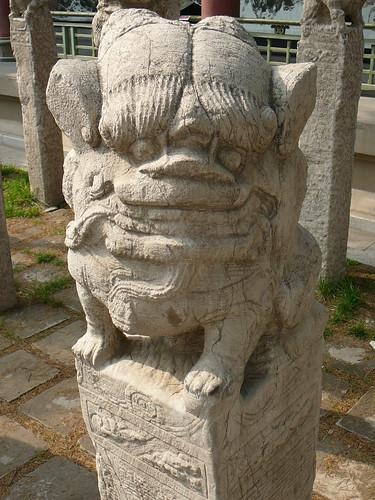
The western wing of the museum is given over to sculptures and carvings discovered in and around burial sites. These include the elaborately designed tomb of Li Shou, a cousin of the then-emperor; massive tomb guardians in the shape of lions, goats, rhinos, and mythical creatures; and “pictoral stones” showing both fantastical imagery—dragons, ghosts, and anthropomorphized animals—as well as more mundane scenes such as hunting and harvesting.
There are also a fair number of Buddhist sculptures. When the religion arrived in China, such artwork was used to educate the illiterate about the faith’s teachings. The museum’s collection ranges from small household relics to large heavenly guardian statues.
The value of the museum’s pieces lies not only in the things themselves, but in the contemplation of how much care and effort—a lifetime of knowledge and craftsmanship—went into their creation. Viewing works so full of passionate labor, one comes a bit closer to understanding lives long past lived.
Yangrou Paomo
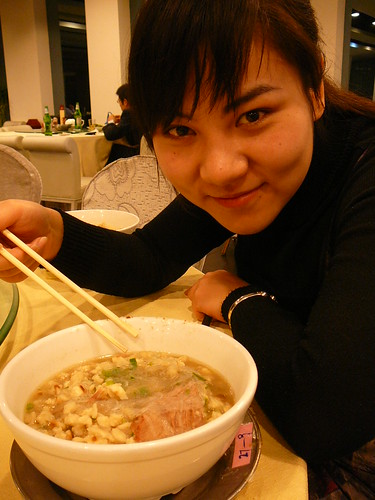
Chances are good that, if you’re a foreigner living in Xi’an, a local has probably taken you out for yangrou paomo. If not, it’s only a matter of time. The restaurants are everywhere; lining the streets of the Muslim Quarter, glimpsed down alleyways, even operating out of swank, high-end venues. Inside many city buses, posters advertising the wonders of Xi’an culture show the terracotta army, the Big Goose Pagoda, the Tang Dynasty show and a bowl of yangrou paomo.
This is the local dish and it’s marvelously simple: Bread, noodles, mutton, spices and broth. For the north Chinese with their traditions of horse riding and long distance hunts, the dish was both simple and filling. A Muslim influenced Silk Road dish, it is said to have originated in the 11th century, at the court of the Western Zhou emperors.
In the heavily touristed areas of the city—like Muslim Quarter—you’ll see yangrou paomo sitting in pre-made bowls (9 ¥), just waiting to have broth ladled into it. While this can be tasty, it’s not the customary way to eat it.
In the better restaurants (20 ¥), you’ll first be asked how many pieces of bread (bing) you want. One will be fine if you have a modest appetite, two will certainly fill you. Once your choice has been made, you’ll be handed the bread and an empty bowl.
What follows is a process of breaking the rounds of bread in half and ripping those halves into small pieces. Whereas a machine compresses the bread, ripping by hand keeps it soft and allows it to retain absorbency. The smaller the pieces are, the better they suck up the broth—and, as a friend insisted to me, if I didn’t tear the pieces up small, the cooks would take me for a country-bumpkin and withhold the choice meat slices.
While thorough ripping can take time, Chinese insist that the whole business can have a relaxing, almost zen-like quality. You become part of the cooking process.
Ripping done, the bowls are whisked away and returned several minutes later full of broth, vermicelli noodles, and slices of mutton. Served along with the meal is a spicy chili paste and sweet pickled garlic which can either be eaten on its own or mixed into the bowl.
This is kou tang (mouth soup); it is what you can expect to be served if you don’t specify otherwise. If this doesn’t quite appeal, several other options are available: Dan zou (walking alone) is a version where the broth, meat and noodles are served up with the bread, as yet still whole, on the side, ready to be dipped in. Gan pao (dry soaked) is the standard yangrou pao mo drained of its broth, but still soggy. And, most wonderfully named, is shui wei cheng (water besieged city) which is just your typical paomo bowl brimming with broth.
The best way to eat yangrou pao mo is to work around the outside toward the center. Since the bread is thoroughly soaked in broth, it is quite hot. Avoiding the center of the bowl bypasses the hottest portion and leaves the roof of your mouth intact, allowing you to enjoy Xi’an’s signature dish with the utmost satisfaction.
Banpo Museum
Banpo Museum is itself something of a relic. Old photos near the entrance, show the site in the early 50s, at the time of excavation. A few archeologists stand amid locals. Around them stretch empty fields. Now the place is surrounded by roads and buildings and getting there requires a long bus ride to the eastern suburbs, beyond the Chan River.
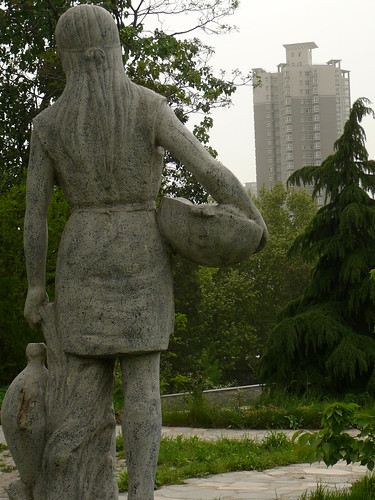
The museum displays the remnants of a 6000 year old village. Covered by a large warehouse building are the remains of numerous huts, identifiable by numerous stake holes in the ground. Wooden frames, subsequently filled in with mud and straw, were set in the holes.
Archeologists suspect that the Yangshao culture which inhabited the site was matriarchal (e.g. run by women). Female burial sites contain far more objects than male ones, leading researchers to believe that women’s position in the society was elevated.
In addition to these burial sites, archeologists have unearthed a great deal of pottery used to bury dead children. A number of storage pits have been excavated too, along with a portion of the deep moat which once surrounded the village.
Other buildings contain artifacts from the site and less obviously relevant displays such as animal fossils.
The nicest part of the museum, however, is the least historical part. Outside the main building is a large garden area full of peony flowers and reconstructions of the Neolithic huts. The whole place is in a state of quaint disrepair, but the upshot is that you find yourself able to sit in relative peace and quiet.
Chinese Calligraphy
How does one express his inner nature? How can we best judge a person’s soul? For the imperial Chinese, writing offered the window. Zhang Xu and Huai Shu, two Tang dynasty calligraphers, for example, would get liquored up and launch into shouting tirades as they performed their art. Zhang, it is said, would often use his hair in place of a paint brush. Not surprisingly, the two avoided standard writing styles in favor of freer forms.
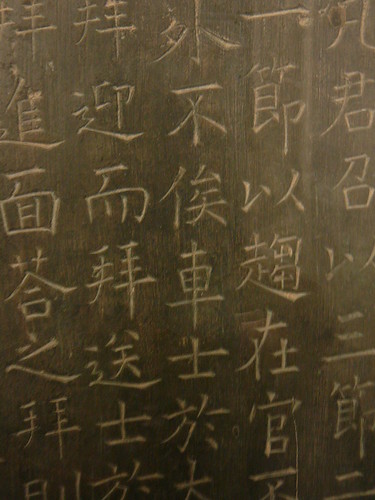
Nowadays, when we think of Chinese script, we tend to separate it into Traditional and Standard. When confronted with the thought of learning the former, those of us unable to learn even the latter shudder. Yet both are merely a fraction of the range of characters once in common circulation among literate Chinese. What we think of as “written Chinese” is just kaishu style, the simplest of five possible scripts.
The oldest style of Chinese writing is zhuanshu, or Seal Script. Originating several thousand years ago, it conveys a sense of visual antiquity. The characters are long, narrow, insect-like, almost otherworldly. The impression is far more literal than other, more abstract scripts. It was the official writing style of the Qin dynasty.
Lishu script, or Clerical Script, followed. Much faster to write than Seal Script—and, therefore, more suited to use in bookkeeping—it retains some of the same elongated qualities as its predecessor.
The other three major scripts emerged concurrently during the Han. Two of these, caoshu (Running Script) and xingshu (Walking Script), are cursive versions of the clerical script. As the names suggest, caoshu is the more flowing and difficult of the two while xingshu moves between the two extremes of precision and wild abandon. Kai (Standard Script) is a further, squarer, less-stretched version of the clerical script.
Within a single style there are a range of techniques. Connoisseurs of calligraphy can rhapsodize about how the smallest action can alter the sense of a character. Whether one uses the edge of the brush or the tip, how long the brush is used before refreshing the ink, how much pressure is applied; the choice of both style and mode of expressing it speaks volumes about the calligrapher.
Yet, beyond reflecting the personality of the individual calligrapher, calligraphy is also a conversation between the present and the past. Great artists carefully study the examples of past masters. (Consider Wang Xizhi, the forth century scholar and “Sage of Calligraphy.” Not only was he a beautiful calligrapher in his own right, refining styles in a manner still emulated to this day, but he also labored to collect the work of many others, past and present. His most famous work is his preface to Literary Gathering at the Orchid Pavilion, a collection of poetry by artists he’d brought together.)
To appreciate and to produce calligraphy is thus both an individual and a collective act of the most surpassing subtlety and beauty.
Saturday, May 1, 2010
WISDOM OF THE WORLD - WEEK 104

A Mermaid Named Veronica
There once was a mermaid named Veronica who had very long beautiful hair. All the sea creatures could see her hair coming long before she got there. They would wait to see her, greeting her with enthusiasm and joy.
"Hi, Veronica!! How are you today?" This made Veronica feel very special and loved. She would always answer back, "I'm doing very well, thank you. How are all of you?" Then they would chat for a bit and she would swim on. She became so used to this way of life that it started to become a bit of a rut. She craved something new and different, but wasn't sure what.
One day she knew what she was meant to do: cut off all her beautiful hair. She took a swordfish and cut off every bit of her prized possession. She soon became painfully aware of the fact that no one noticed or greeted her anymore as she swam by. They didn't recognise her and she was too embarrassed to say anything. She knew that they would all ask about her hair and she didn't want to explain why she had cut it. She wept. Nothing seemed to matter anymore: it was as if she had ceased to exist. At times, she desperately wanted her hair back, but deep down she knew that that wasn’t the answer. This depression lasted for many moons until one day she woke up. She looked around. All different colours, shapes and sizes were displayed among the sea life and each mermaid looked completely and totally unique. She realised in that moment that she would always be unique and special, with or without her hair. She didn't need others to notice her in order for her to feel this way. She swam off with glee, knowing she could be happy just the way she was.
Laura Cade