Saturday, January 30, 2010

WISDOM OF THE WORLD - WEEK 93


The Wooden Bowl


A frail old man went to live with his son, daughter-in-law, and four-year grandson. The family ate together at the table. But the elderly grandfather's shaky hands and failing sight made eating difficult. Peas rolled off his spoon onto the floor and he always seemed to spill the milk.

The son and daughter-in-law became irritated with the mess. "We must do something about Grandfather," said the son. "I've had enough of his noisy eating and the mess".
So they set a small table in the corner where the grandfather ate alone using a wooden bowl so he wouldn’t break it. When the family glanced in Grandfather's direction, sometimes he had a tear in his eye as he sat alone. Still, the only words the couple had for him were sharp admonitions when he dropped a fork or spilled food.

The four-year-old watched it all in silence. One evening the father noticed his son playing with wood scraps on the floor. He asked the child sweetly, "What are you making?" Just as sweetly, the boy responded, "Oh, I am making a little bowl for you and Mama to eat your food in when you get old." The four year old smiled and went back to work.

The words so struck the parents that they were speechless. Though no word was spoken, both knew what must be done. That evening the husband took Grandfather's hand and gently led him back to the family table. For the remainder of his days he ate every meal with the family. And for some reason, neither husband nor wife seemed to care any longer when a fork was dropped, milk spilled, or the tablecloth soiled.

Thursday, January 28, 2010

Food Comedy, Food Amazement

It's "Xtreme Wild Berry Jello" Hello Kitty! Made for a bento box!

Heehee! Original image from Flickr, here.

Salmon mousse with cukes! incredible! love it so much! from Flickr, here.

Eeeheehee! I can't get over how cute and cool this picture is!! Heehee!

this is PURE INSANITY. a Jello mold found at an Asian grocery store... pic from here.

Art in China


Living in Istanbul, many of the more obvious foreigners I’d known—ruddy faced Brits, in particular—were marks for the small con. Prowling up and down the tourist crammed thoroughfares was always an assortment of well dressed, friendly, slick haired guys, all on vacation from, say, Cypress, all just wanting to know the time, all of whose initial queries led to small talk and an invite to some club they’d heard was good. The club’s prices, not touched on when ordering, always came as a shock to all. The foreigner, feeling sympathy for his newfound friends, would dutifully shell out serious cash and head back to his hostel feeling miffed at how they’d all been fooled.

Now, this never happed to me. Not because I blend in seamlessly to Turkish crowds, so much as I’m generally unfriendly and suspicious to any and all comers. The few times I’ve been in such situations, I’ve realized quickly or declined the offer to get a drink out of a pure, suspicion-free anti-sociality.

Well, my second day’s goal of museum going got sidetracked from the get-go by precisely this sort of business. Interestingly, while past examples of these cons had always come at me in the form of practiced suavité, the Shanghai version came in the form of two rather thread-bare students. Making my way toward the Museum of Chinese Art I was stopped by a brother and sister duo. The brother, Jerry, who did the stopping, asked me where I was from and how I liked the city. Honestly, this didn’t set off any alarm bells. (I’d already been stopped several times in these first few days—on several occasions, people had requested that I pose with them for a picture—so this was nothing new.) However, after ten minutes of chit chat, there was a lull, followed by the suggestion that we go to a tea tasting that was somehow, unclearly, tied to a Chinese minority people’s exposition that was taking place somewhere. They had, you see, been heading there when they met me. Would I like to come along?

Shanghai being a safe place—not the sort of burg were you walk down a back alley and find yourself kidnapped and shipped off to a faraway land—I decided to see where all this led. So we headed off in—though I chose not to point this out—the precise opposite direction from which they had been heading when we first met. After first heading down a main street we turned onto a major backstreet and headed into a shopping mall. This mall was nothing more than a few stores selling plasticy athletic shoe knock offs scattered amid an otherwise desolate environment of empty, dusty, unoccupied lots. We walked up to the third floor, past a nail salon and what appeared to be a pet store to a small office space converted into a pair of private tea rooms. I felt somewhat bad for Jerry and his largely silent sister at seeing the shabbiness of the con. They seemed nice and enough and his English was good enough. They really deserved a better infrastructure to back them up. Once I established that cups of tea were about ten dollars a pop, I politely said my goodbyes and made my way back down, past the empty glass shop fronts and scruffy howling dogs. . .

Yet if we’re speaking of deserving and getting the proper trappings, we must talk of the Shanghai Museum. The place was a knockout full of exactly the sort of high quality goods you imagine a society churning out over two thousand years of civilization. The imagery failed to pack the sheer hallucinatory punch that I remember feeling at the National Archeology Museum in Mexico City (There I remember looking at pieces of art and feeling as though I were seeing thoughts utterly alien represented. The stuff there seemed to have to referent in the western art tradition I’d grown up in. The animating minds behind those objects had journeyed down roads I’d never contemplated.) Here, though the motifs were more recognizable, it was the aesthetic experience that stuck.

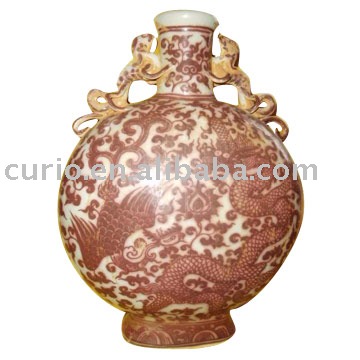
About two years ago, making my way through Topkapi Palace Museum, I’d wandered into a room that displayed objects the Ottomans had received via the Silk Road trade. Prominent was a series of the most delicately painted china places, all of the most beautiful blue and white. Looking at those objects, I tried to imagine how the Ottomans must have thought of them, wondering if they sensed the Ming Dynasty to be some powerful force out there beyond their ken of which these perfect little objects was merely a mote in the eye. Did the Ottomans feel there were looking at the tip of an iceberg when they looked at these plates? Well, I when looking at them thought how marvelous a place must be that could produce such things. I thought to myself how fascinating it would be to live in such a place and breath a bit of that tradition.

And the Museum didn’t disappoint on these grounds. It had vast areas devoted to bronzes, jades, coins, and ceramics. These last were my favorite. Arranged chronologically, they moved from the most utilitarian-looking of clay containers to more finely crafted porcelains.

Initially, it was the statues that were most striking. Ducks and other animals, painted in fairly unremarkable shades, during the early Han dynasty (c.200 BC-200 AD) morphed into more odd imaginings—pots shaped like terraced houses packed with small carved figures looking off of balconies and musician figurines with smaller, assistant musicians springing of their chests and shoulders—during the subsequent Wu and Jin periods.

Then, with Tang dynasty (600-900 AD) came large, loving carved figures of camels and fierce statues of Buddhist heavenly guardians. These statues were all painted in vibrant, dripping browns, greens and oranges that seemed to fever-dreamishly melt into one another. Of all the earlier art on display these Tang pieces were the most sucessful in their ability to draw you into an utterly separate aesthetic world.

Whether the museum’s collection accurately reflected the culture’s output, I can’t say, but the sculptures definitely dropped off at this point and plates and vases took over. Initially, with the Song dynasty wares, this was not very noteworthy. The Song managed some gorgeous glazes, but that was about the whole of it. Once the Mongols (1100-1200 AD) came onto the scene, however, conquering in this direction and that, things became interesting. Persian and Islamic geometrical motifs started to appear alongside dragons. Plates started to look more like “china plates” with the soft white of the plate covered in dark-blue brush work. The Ming (1300-1600 AD) threw some red into the mix and took to painting women, families and little towns on riversides.

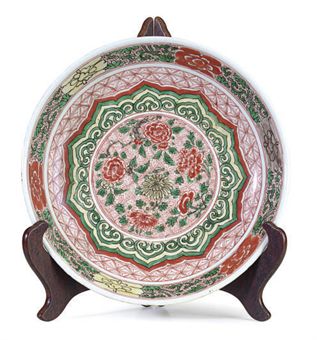
By the time the time the Qing entered the picture around 1600 it was clear that porcelain plates had become big business. The emperors were paying close attention to what was coming out of the kilns, appointing special envoys at the great pottery-works facilities across the empire. Since the early Qing emperors tended to live a long time and exerted such control, the ceramic designs feel as though they can truly be periodized. Each period seems to have produced something more magical than the next. The ones from the Kangxi reign take the motifs of the Ming and perfect them. Under his son, Yongzhen, there is a great deal more color thrown into the mix as well as an obsession with peaches and flowers.

The peak comes under Qianlong where each motif—be it dragons or fruit or old men carrying water buckets—achieves its perfect expression. Moreover, the colors and textures of the lacquer rise to new levels; there are imitations of marble, wood, and bamboo. New colors—pastels and subtle combinations of old choices—are introduced as well.

Ceramics aside, the most impressive display was the furniture exhibit full of richly carved sandalwood chairs, cabinets and room dividers. The rooms featuring jade and coins were also exemplary, but coming to them in the forth hour of my five hour tour, the shere abundance was daunting and too much to properly process.

The least impressive rooms were the painting and calligraphy galleries. In both cases I can only assume my boredom is largely a result of my unfamiliarity with the techniques involved. The paintings merely seemed a monotonous repetition of birds, trees, mountains, rivers and streams. Each artist’s title card would give his name, period and glaringly obvious specialty (ie. “mountains”). Occasionally an artist would paint something more interesting—demimonde paintings and parties—but no one seemed to have the eye of a Caravaggio or a Velasquez.

Now all this discussion of dinner plates, chairs and so forth might seem a bit boring and over-the-top until you start to consider the effort and skill that went into crafting these things, the lifetime of expertise that was built-up and brought to bear on these objects. To think about the attention that went into such objects is to come closer to the lives of the people who made them. To try and get near that beauty is as close as we can get to that time and that place. That’s why I have trouble with my inability to connect with any of the Chinese paintings. Here are objects that took long thought and skill to produce and I am unable to appreciate it.

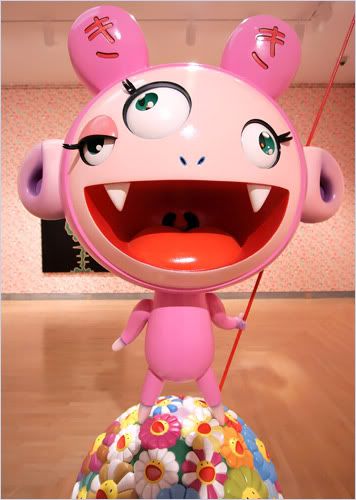
This problem is even more unsettling in regards to modern Chinese art. The following day I headed to the Shanghai Museum of Contemporary Art (MOCA), a pretty little building in the middle of People’s Square, nestled between trees, guarded by two huge, golden, Koons-Murakami-style cartoon cat statues.

These cats are a pretty good indication of what’s on display inside. Whereas the first museum was guarded by recreations of palace beast sculptures, whose presence recalled memories of past Chinese accomplishments, these . . .well, these were just cartoons. Hell, inside everything was a cartoon. Currently on display was something called “The Animamix Biennial.”

Now, according to the New York Times, “Animamix” is a term that describes the current trend in Asian art. It’s “characteristics include the worship of youth and the pursuit of an idealized youthful beauty; strong narrative texts and images; and the use of vivid and colorful visuals derived from electronic media.” In practice this means large numbers of paintings where all the characters are drawn in cartoon form, characters recur, and everything looks like a Japanese comic book or as though it should be stitched onto the back of a child’s backpack.

The main name one associates with this sort of art is Takashi Murakami. Not only does his work feature a number of recurring characters and motifs, but Murakami goes the step further by selling his art in forms such as T-shirts and Loius Vuitton handbags. His stock characters tend to be Pokemonesque creatures whose cuteness seems always to be mutating into a fanged nightmarishness. At the Museum his influence could be seen in everything on display.

The MOCA is fairly small I spent around two confounding hours moving through it, trying to get a hold on what these artists were trying to say, trying to feel something in relation to these pieces. It was not a satisfying experience. Picture after picture and installation after installation seemed to be making the same point—namely that life has been turned into a cartoon, edges have been smoothed out, everything has been commercialized and yet, often, burbling beneath the surface of this exists an intense anger.

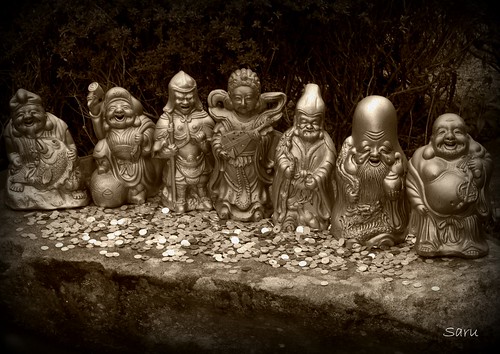
The best example of the overall aesthetic was a painting on the upper floor of the Seven Lucky Chinese Gods—each representing attribute, each with his own identifying item (eg a fish). This was a common motif in Chinese art and there had been several such representations at the Shanghai Museum the previous day. Here the Seven Gods were represented as manga-style characters. Now, on the one hand, there is something witty in the notion of adapting traditional motifs into modern settings, thereby questioning the relevance of their message and, equally, the certainties of a modernity that no longer admits them and can only approach such deep ideas through cartoon simulacra, but it doesn’t go beyond witty and I’m not certain it rises to the level of “art.” It seems mere kitsch. The idea is not new and the constant voicing of the same ideas by so many artists reduces its force.

The problem for me wasn’t the sentiment—in fact it’s very satisfying to know that there is a reaction to the crass commercialism that one sees everywhere in Asian media—it was the undifferentiated means of communicating this message. Even if all these artists felt the same fundamental discomfort, it seemed rather pathetic that they possessed such limited techniques for communicating it. (It’s the same reason I dislike an artist like Lichtenstien who seems to have only one idea and one way of expressing it. It’s the same reason that I only listen to the Sex Pistols once a year. It’s the reason I like artists like Bob Dylan who, finding themselves at festivals singing the same protest songs as everyone else and say, fuck it go electric.)

The sheer, tiring sameness of all this art bore down on me and I took to casting glances at other museum goers. I wondered how they felt about this and whether they were taking the same message from all this. Most of the others museum-goers were Chinese couples or groups of friends. Few seemed to be giving the pictures any sustained attention. Most strolled quickly past or took turns snapping photos of one another.

In my experience, modern art is usually intended to cause a reaction, connect you with a sensation, or intentionally avoid doing so in an attempt to criticize our modern world. Most of this art was squarely in the latter category. Whereas those ancient Chinese artists had tried to capture beauty, these artists seemed to be representing anger, despair and the need to present a plasticized front to the world. I glanced over at a nearby woman flashing a peace-sign, posing in front of a painting of a demon bear backgrounded by candy colored swirls and mulled whether she was as oblivious to the message as I was worn down by it. Though she seemed untouched by it, there was another possibility: To acknowledge and to remain indifferent. This last possibility was the more troubling.

EXAM'S FINALLY OVER!


I JUST LOVE THE FACT THAT I AM FINALLY FREE FOR THE NEXT ONE MONTH!!!!!!!!! YEAYY!!!

...Lady Gaga's eyes in bad romance!...

I thought it was nearly impossible to create it..but i found THIS! and it just look exactly alike in the bath tube scene!

Look at the eyes! Look like one of those anime characters!


Tuesday, January 26, 2010

Photos: Shanghai

Click HERE for photos of Shanghai.

Shanghai, Day One


I arrived in Shanghai late at night and got settled into my hostel later still. By the time I was squared away, the subways were already closed and, having no desire to deal with taxi drivers, I just made a circuit up and down the neighborhood’s main drag. It was dark, cold, and everything was closed. A few bicyclists and cars rolled along while street food vendors stood sentry on corners. And that was about it. From first impressions, Shanghai didn’t seem like much.

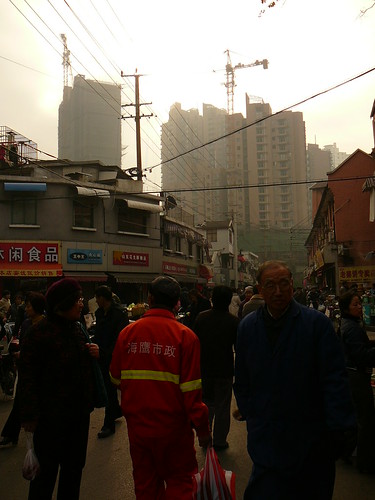
Morning changed this. I was up and out early. People, cars and bicyclists were everywhere and, in daylight, the first thing that hits you is the construction. It would be only minor polishing of the truth to say that, in every direction you looked, something was going up. Here a building encased in scaffolding and green tarp, there a hole in the ground where foundations are starting to take shape, and over there some ugly old building being ripped down in anticipation of a new apartment block. The sheer quantity of work going on—the manpower and material that must be brought to bare—gave me the sensation of standing at the center of an explosion, feeling the release of energy pass through me.

The negative, of course, is dust, noise and the smell of ozone. Think of the annoyance of a single project in your neighborhood. Remind yourself of the need to plug your ears, cover your nose, avoid flying welding sparks, wait for some vehicle to slowly back up across your path; now treble that.

Seeing all this makes running through the numbers inescapable. In a city of 16 million, even if every apartment housed a thousand, that still implies 16,000 blocks of apartments. So, I suppose, there was a market for all the new apartments. As to the office complexes, I was less certain. Across the Huangpu River, a vast area, only a decade removed from lying fallow, had been designated for commercial development; now it bristled with skyscrapers. Yet, no matter how much manufacturing was being done in China, and no matter how much this necessitated mustering and quartering an army of financiers, asset managers and so forth, I couldn’t see it requiring as much office space as was on offer. It was only a hunch, but a few stops into various little malls revealed swathes of unrented space. I suspected that many of those new office buildings were rising-up on faith and lacking in confirmed residents.

My first day’s goal was to go to the central People’s Square and the fashionable Xintiandi district south of there. Doing this necessitated subway navigation which led first to confusion and then to redirection by a friendly man who saw me staring dumbly at the subway map—literally everyone I have interacted with thus far has been helpful and friendly, not a single store owner, restaurateur or vendor (with the exception of those in the most heavily touristed areas) has quoted me an unreasonable price. Once reoriented, I discovered the ticket machines only accepted coins and so set off on a quest to break a large note. This took me into a series of back streets in search of a corner store. Instead I came across a sprawling marketplace.

Whereas markets in Istanbul had been rather dull affairs where every vendor seemed to have fairly similar items, and not a wide variety at that rate, this one was pleasantly varied. There were street vendors selling meat skewers, streamed dough balls filled with meat, sesame covered fried rice balls, potstickers, and a thin, flaky fried bread layered with green onion that I remembered gorging on during my last time in China.

Vegetable-wise all the usual suspects were present as well as the sort of things I’d only seen before as specially featured and highly marked up in Asian specialty markets—here it was all run of the mill. And then there were varieties of vegetable that were utterly new to me—troughs filled with things resembling, if not actually, seaweed.

Fruits and meat were fairly standard—although, as with Turkey, there were far more meat specimens on display (unlike Turkey, many of these were pork.) Chief among these were pig and chicken feet, the latter of which I have eaten and would discourage anyone who didn’t grow up enjoying them from bothering to sample.

Finally, there were the live animals; cages upon cages of live chickens and ducks, tanks full of snails, clams, eels and fish. I watched as fish were selected, snatched up flapping wildly, and unceremoniously chopped up then and there. A little ways towards the edges, where the vendors thinned out, one lady was selling giant frogs out of a burlap bag.

Now, maybe I’m just romanticizing the whole thing—perhaps its just some middle-class faux-anti-modernism that makes me love this sort of thing—but I fell such pleasure passing through markets of this nature where the blood and guts are right there to see and nothing feels hidden.

Once finished snacking and breaking bills at the market, I caught the subway down to the Xintiandi district. Emerging I was, naturally, confronted by a towering, half-constructed building encased in green tarp. Once I had turned to the left, however, I was met with a less expected sight. A long street of newly constructed, one and two story buildings all with beautiful redbrick facades. Each store housed either name-brand clothing or the sort of upper middle class boutique one might find scattered through any rich city’s more upscale neighborhoods. None of these stores had Chinese prominent and every street sign on this and surrounding streets was bilingual. I had expected Shanghai to be a fancier affair than any part of China I might have seen five years earlier, but I had not expected to be plopped down into Park Slope, Brooklyn.

I walked widely around the neighborhood, feeling extra out of place surrounded by well dressed Chinese in a pair of jeans and a worn-out Carhart jacket. The area contained such sights as the Shanghai Music conservatory—the only place I’ve ever been where good classical music cds can be bought out of street vendors’ cardboard boxes—and a wonderful park where I watched children and old men flying kites. The sky above—the whole sky, the entire time I was in the city—was a murky grey which I first took to be intense pollution, but gradually realized to be a perpetual haze of fog. The fog was so thick that, walking down a wide city street, I could not see more than four blocks on several occasions. I can only imagine the city in summer to be a nightmare of humidity.

On my way through the neighborhood, I came across a sight, utterly banal, but shocking in so far as it juxtaposed itself with the day’s earlier visions: A larger, chain-style supermarket across from which were, set up in the same red-brick-façade-style buildings, a series of food vendors hawking the same snacks I’d seen earlier. Yet, instead of operating out of carts and crumbling little holes-in-the-wall, they were ensconced in this fancy permanence. Here I could see an anthropologist’s wet dream—“the cooption of traditional market practices into new economic matrices” or some-such. Point of fact, though, it was a surprise to see what I had earlier gloried in experiencing, here reproduced in a manner more reflective of a mall food court.

I hiked north from Xintiandi to the People’s Square—not a square so much as a vast park peppered with museums, concert halls, rides, cafes, little lakes, benches for game playing, and paths for strolling. Over my time in the city I witnessed all those typical activities as well as a lone teenager practicing judo on a helpless tree and a crowd of several dozen older people, signs hung all about them, trying to find marriage partners for their unmarried children—this latter affair being, apparently, a weekly event.

The north side of the park is bounded by Nanjing Road. This is the main pedestrian street of the city and it should be ranked among the wonders of the urban world. It hits you in an explosion of neon light. Throngs upon throngs move up and down it, in and out of thousands of shops. Stores burst with customers. Snaking off it are shadowy backstreets lined with restaurants, spilling over with customers. In front of these are vendors selling food off carts.

Back on Nanjing Road the crowds continue to surge up to the park and its surrounding attractions and down toward the Bund, the embankment along the Huangpu River upon which all the old European-style commercial buildings are set. Normally pedestrians can walk along it, taking in views of the gloriously colorful skyscrapers across the way (among which is a space-ship-looking beast of a building which puts the Space Needle to shame.) At the moment, however, the entire embankment was under construction. As a result the sea of people making their way down Nanjing Road bottlenecked on the final street corner and took their pictures from there. And I, not having brought my camera along, simply stood looking out across the water thinking how ephemeral my once secure American world now felt. In all the smiling faces I saw up and down that road I felt as though I were seeing the future. I wasn’t sure I saw myself reflected.

Introduction


Somewhere, buried deep within a behemoth copy of Mote’s Imperial China, 900-1800, I remember coming across the most romantic of ideas. The historian was describing the activities of some barbarian king out on the periphery of the Chinese empire. While the Chinese themselves were busy knuckling down into one of their declinatory phases, this particular king was vigorously building his own little empire. He was importing scholars, offering pay at good rates, as well as constructing a city for his once nomadic people. He was out there in the wilderness, striving, creating a new world out of thin air. I forget his name, I forget the year, all I remember is the beauty of the idea. How must it have felt for that king to have watched a new world rise up around him?

I wonder if a Chinese—at least one living in a major city—feels something approaching those same feelings. To be living in the country at the moment is to see a new world springing up at every turn.

Saturday, January 23, 2010

WISDOM OF THE WORLD - WEEK 92


Damned Devotee

by Anthony de Mello

The devotee knelt to be initiated into discipleship. The spiritual teacher whispered the sacred words (a mantra) into his ear, warning him not to reveal it to anyone.

"What will happen if I do?" asked the devotee.

Said the guru, "Anyone you reveal the mantra to will be liberated from the bondage of ignorance and suffering, but you yourself will be excluded from discipleship and suffer damnation."

No sooner had he heard those words, than the devotee rushed to the marketplace, collected a large crowd around him, and repeated the sacred mantra for all to hear.

The disciples later reported this to the spiritual teacher and demanded that the man be expelled from the monastery for his disobedience.

He only smiled and said, "He has no need of anything I can teach. His action has shown him to be a guru in his own right."

Tuesday, January 19, 2010

Around the peninsula

Scoil Mhuire formal 2010 Teachers and committee


Scoil Mhuire formal


iCare Moulin Rouge night


Current Board of Directors for Buncrana Credit Union


Past Board of Directors Credit Union Buncrana


Past Board of Directors Credit Union Buncrana


Staff of the Buncrana Credit Union at the 2010 AGM


Crana College Buncrana - Teachers

Monday, January 18, 2010

Cat Cakes

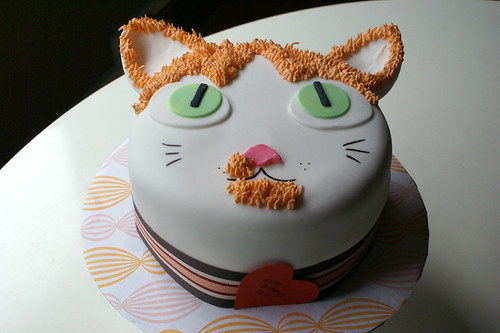
Oh, the comedy and the hilarity of cat themed cakes. There's some crazy ones out there! I made this one a while back, Harold the cat...

Harold The Cat Cake!!

my little buddy Harold the cat, based on a real cat...

Separated At Birth?

Separated at birth! Or separated by a computer printer!

This little black and white kitty cracks me up so hard... Great cake and great cat...

This is soooo grody too yet fascinating: THE CAT LITTER CAKE. Made from cake, tootsie rolls, crunched up crackery things... ugh so sick. Here is a link to the recipe and how-to. In case you want to gross yourself out super hard by eating "cake" out of a litter box.

Sunday, January 17, 2010

WISDOM OF THE WORLD - WEEK 91


One Cottage Burning

Years ago, a fishing fleet went out from a small harbour on the east coast of Newfoundland. In the afternoon there came a great storm. When night settled down, not a single vessel of all the fleet had found its way into the port.

All night long, wives, mothers, children and sweethearts paced up and down the beach, wringing their hands and calling on God to save their loved ones. To add to the horror of the situation, one of the cottages caught fire. Since the men were all away, it was impossible to save the home.

When the morning broke, to the joy of all, the entire fleet found safe harbour in the bay. But there was one face with a picture of despair - the wife of the man whose home had been destroyed. Meeting her husband as he landed, she cried, Oh, husband, we are ruined! Our home and all it contained was destroyed by fire!"

But the man exclaimed, "Thank God for the fire! It was the light of our burning cottage that guided the whole fleet into port."

Tuesday, January 12, 2010

Laptop Sound Fix

Photobucket

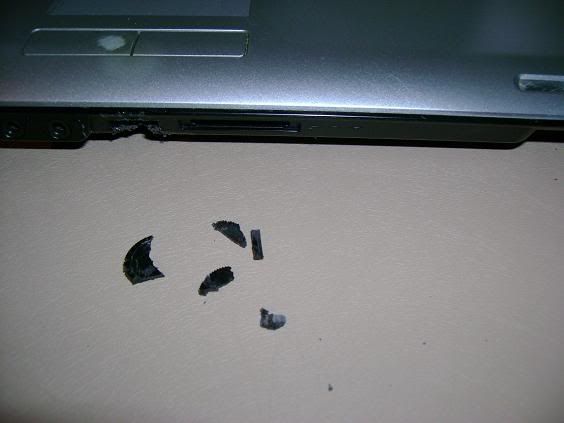
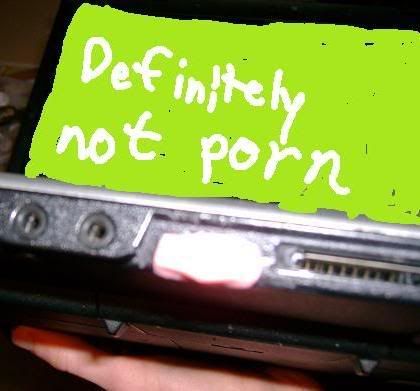
If you're like me, the biggest problem on your laptop computer is the volume knob. It's always getting in the way when the computer is in your lap, changing the volume way up or down without you knowing. And mine is even worse because for whatever reason, it's messed up and turning it both to the right AND to the left will increase the volume. There's only one choice: to destroy it.

Photobucket

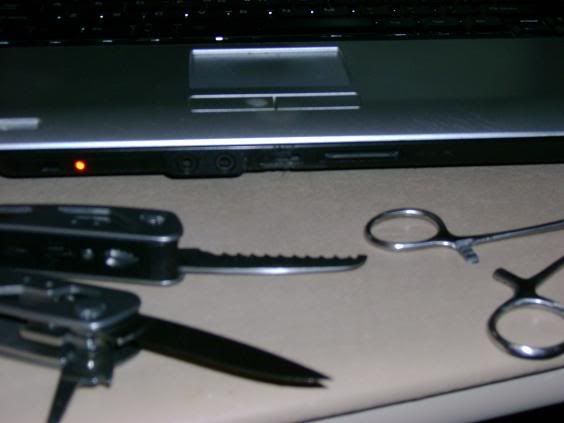
The main issue here is that it's way in there and hard to get at, so you're going to need a few tools to do this. Pliers may seem like what you need at first, but they're just too big for this job, so you should get your hands on some curved arterial forceps. You might think to move down to a thin tweezer like from a swiss army knife, but those just won't provide the kind of grip that you'll need even though they're just about the only thing that's going to fit in there.

Photobucket

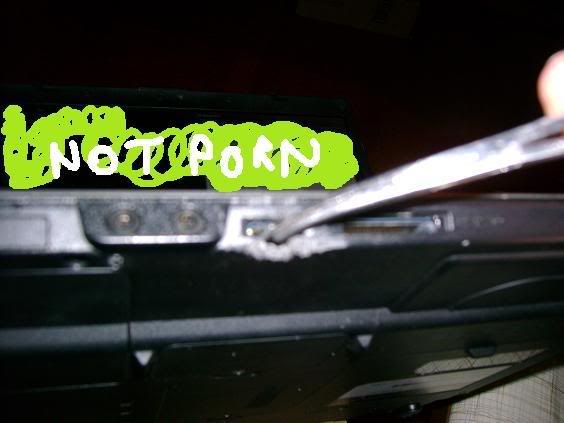
So what needs to happen is to cut open some more working space around the top and bottom of the volume knob. A wood saw is pretty good at removing some of the plastic, but you might want to file it after you're done to get rid of any jagged edges. Once you've done that, just take your forceps and get a good grip on the knob, then bend and pull until you bread off enough pieces of it. You're probably not going to be able to remove the core of it unless you actually open up your laptop, which may not be an option for you if you're already ground out the screws on the back in a previous operation. Also, opening up the back will probably mean you should turn the power off first and we want this to be a simple outpatient procedure.

Photobucket

After you're satisfied with how much you've torn apart that volume knob that has been causing you endless torment all these years, it's time to close up the wound. Caulk might be a good choice, but chewing gum is a lot more prevalent, in fact you probably have some in your mouth right this second, so just take off a piece of that and fill up the hole you've made. Once it's dried up, you'll have a nice battle scar to impress chicks with.

Sunday, January 10, 2010

WISDOM OF THE WORLD - WEEK 90


Dust if you must

Dust if you must, but wouldn't it be better to paint a picture, or write a letter, bake a cake, or plant a seed.

Ponder the difference between want and need.

Dust if you must, but there is not much time, with rivers to swim and mountains to climb! Music to hear, and books to read friends to cherish and life to lead.

Dust if you must, but the world's out there with the sun in your eyes, the wind in your hair, a flutter of snow, a shower of rain, this day will not come round again.

Dust if you must, but bear in mind, old age will come and it's not kind. And when you go, and go you must, you, yourself, will make more dust

Wednesday, January 6, 2010

Burt Geneology


The Burt page on The Donegal Genealogy Resources website has recently been updated to include extensive details of Burt Cemetery.

A large number of headstone inscriptions, including photographs, family links and also some links to the 1911 Census have been added.

Every effort has been made to catalogue and identify as many graves as possible in the Burt Graveyard, in an effort to help preserve the identities and locations of the people buried there for future generations and also to enable emigrants from Burt to find and see their family graves.

Check out the site....

Friday, January 1, 2010

WISDOM OF THE WORLD - WEEK 89


ORANGES

A man was selling oranges in the middle of a road. He was illiterate, so he never read newspapers. He put some signs along the road and spent the whole day praising the flavour of his wares.

Everyone bought from him and the man thrived. With the money he placed more signs on the road and began to sell more fruit. Business was growing fast when one day his son - who was educated and had studied in a big city asked him:

"Father, don't you know that the world is going through very hard times? The economy of the country is in an awful state!"

Worried by this, the man reduced the number of signs and began to sell fruit of inferior quality because it was cheaper. Sales slumped immediately.

"My son is right," he thought. "Times are very hard."